Robotics Data Collection: Why the 10,000th Demo Teaches Your Robot Nothing
| TL;DR Your robot policy generalizes with the spread of environments and objects in the data, not with the raw count of episodes.Published imitation learning research found returns flatten once demonstrations per environment or object cross a threshold.The 10,000th demo of the same scene teaches your model almost nothing the 200th already taught it.Plan robotics data collection as scenario slots across rooms, objects, placements and demonstrators.Freeze an evaluation set your training data never touched. Without it, nobody can prove the last round bought anything. |
| Why do extra robot demonstrations stop improving performance? Extra demonstrations stop helping once your policy has seen enough repetitions of the same scene, the same object and the same demonstrator. Generalization tracks the number of distinct environments and objects in your dataset, and that relationship follows a rough power law. New coverage restarts learning. More repetition inside old coverage does not. |
A robotics lead I spoke with had a number he was proud of. Fourteen thousand demonstrations. Clean ones. Two quarters of work and most of a data budget went into that number.
Then he ran the policy in a customer warehouse and watched it fumble a shelf it had never seen. Same task. Different room. Almost nothing transferred.
He asked me what went wrong with the collection. Nothing went wrong with the collection. It did exactly what it was built to do, which was record one situation fourteen thousand times.
That is the quiet problem sitting inside robotics data collection right now. Teams buy demonstrations. Models learn distributions. Those are not the same purchase, and no invoice ever tells you the difference.
So here is what the next ten minutes give you. A way to tell which part of your dataset stopped teaching, and a way to decide what the next round should actually buy.
What robotics data collection actually buys you
You pay for coverage, not repetition
Your policy fits the distribution it sees. That is the whole mechanism, and it is less mysterious than the field makes it sound.
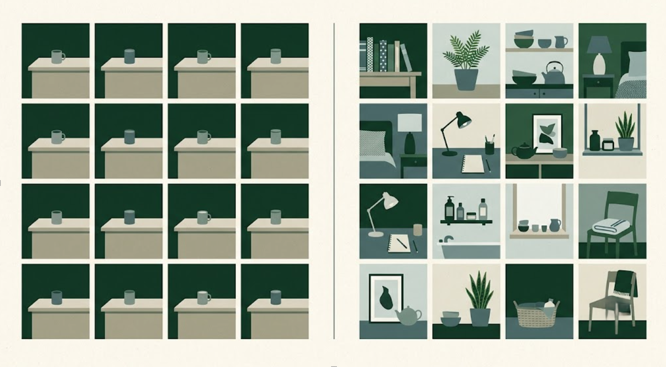
Two thousand episodes shot on one counter top is not two thousand lessons. It is one lesson, filmed two thousand times.
Picture a language model reading the same page on repeat. It does not get smarter. It gets very confident about that page. Robot training data behaves the same way, and the invoice looks identical either way.
Why episode count became the number everyone quotes
Episode count is easy. Easy to count, easy to bill, easy to line up in a spreadsheet next to another vendor.
Coverage is awkward. No clean unit, no standard line item, so it goes unmeasured and unpriced.
And here is the part that bugs me. Markets optimize what they get paid on. Most data suppliers still lead with hours captured or episodes shipped, because that is what buyers ask for. Very few lead with how many distinct rooms the data came from. That is not sloppiness. That is a pricing model.
You can push back on it in about ten minutes.
The coverage curve: four bands where your returns change
Data spend does not stop working all at once. It works, then it works less, then it mostly stops. The shift happens in four bands, and each band has its own tell.
| Band | What the episodes teach | Plateau symptom | What restarts the curve |
| 1. Task shape | The motion, the goal, what success looks like | The policy fails even in the room where it trained | More clean repetitions of the same scene, plus stricter acceptance |
| 2. Object spread | The policy stops keying on one specific instance | Works on the training object, fumbles a taller or softer one | New object instances inside each existing scene |
| 3. Environment spread | The policy stops keying on background, layout and light | Works in the lab, fails at the pilot site | New rooms, new layouts, new times of day |
| 4. Demonstrator spread | The policy stops copying one person’s habits | Brittle recovery, breaks when the approach changes | Rotate demonstrators, allow several valid strategies per task |
Band 1. Task shape
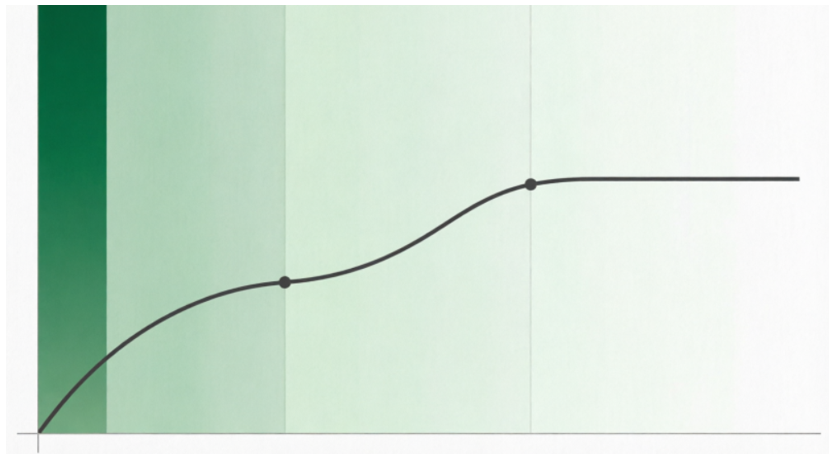
Early on, repetition is the right buy. The policy needs to see the motion enough times to learn what the task even is.
This band is also where the bad habit forms. It is the only stretch where episode count and progress move together, so teams learn to trust a number that stops meaning anything about three weeks later.
Band 2. Object spread
Swap the mug for a taller one and watch the success rate fall off a cliff. That is band two announcing itself.
Research on data scaling in imitation learning found that generalization to new objects rises roughly as a power law with the number of training objects, and that demonstrations per object stop mattering once they pass a threshold. The team behind it collected over 40,000 demonstrations and ran more than 15,000 real world rollouts to test it, so this is not a hunch from a blog post.
Band 3. Environment spread
This is the expensive band, and the one most buyers skip. New rooms cost more than new objects, so plans quietly stay indoors at one site.
The same study built a recipe out of the finding. Data from 32 environments, one unique object in each, 50 demonstrations per environment, produced a policy that hit roughly 90 percent success in scenes it had never seen. Treat that as a shape to reason from rather than a number to copy, because your task complexity moves it. But look at the ratio. Wide and shallow beat narrow and deep.
Band 4. Demonstrator spread
A dataset built by one person teaches one person’s habits. Approach angle, pace, the little recovery move they always make. The policy inherits all of it as if it were the task.
Multi site collection programs rotate operators for exactly this reason. Some variation in how a job gets done is signal, not noise. A dataset where every episode looks identical produces a policy with one plan and no fallback.
Where the ceiling actually sits
Now the honest caveat, because the opposite mistake is just as costly.
Volume still pays once diversity is high. In one large pretraining study, average scores climbed from 0.28 with no pretraining to 0.47 at 100,000 demonstrations, 0.53 at 250,000 and 0.58 at a million, with task diversity kept broad throughout. Scale compounds on top of coverage. It just evaporates without it.
So the rule is not collect less. The rule is collect wider before you collect more.
Read your own plateau before you fund another round
You do not need a research team to work out which band you sit in. You need one evaluation run and a bit of discipline about changing one thing at a time.
| What you see in evaluation | The band you are stuck in | What to fund next |
| Success drops when the object changes | Object spread | New instances per scene, before any new episodes |
| Success drops when the room changes | Environment spread | New sites, layouts and lighting conditions |
| Success drops when someone else sets up the scene | Demonstrator spread | Planned rotation across the contributor network |
| Success holds in evaluation but falls in the pilot | Your eval set mirrors your training set | A frozen eval set drawn from unseen conditions |
| Success is flat everywhere, training scenes included | Task shape or label quality | Acceptance gates and annotation review first |
Same policy, same checkpoint, vary one axis at a time. Most teams change three things at once, get a confusing result, and buy more episodes out of habit. You can skip that quarter.
If you want the deeper version of this diagnostic, the data yield rate breakdown covers how usable episodes get separated from inflated hour counts.
Where coverage actually comes from: four sources, ranked
Once you accept that coverage is the purchase, the sourcing question changes. Here are the four routes teams use, ordered by how much environment and demonstrator spread each one buys you per unit of effort.
1. A managed contributor network across many markets
This route wins the top spot for one reason. Environment spread is the thing it sells, and no other route delivers it without you building field operations from scratch.
Humyn Labs runs physical AI data collection across 20 plus countries, which matters because deployment markets for home and industrial robots look nothing like a lab floor in one city. The sight modality alone sits at 10,000 hours with episode level annotation and a discard rate under 15 percent, so weak episodes get dropped before they eat your annotation budget rather than after. One pipeline handles sourcing, synchronization, validation, processing, QC and benchmark evaluation, then ships in the formats your training stack already reads, including MCAP, RLDS and LeRobot v3. That last detail sounds boring until you have spent a month reformatting somebody else’s delivery.
Why it matters to you: you get room to room variety you cannot buy from a single lab floor, delivered as training ready episodes instead of raw footage you have to repair.
2. In house teleoperation
Best precision, worst spread, and the honest default for contact heavy tasks.
You control every variable, which is exactly why the data ends up narrow. Your operators work in your space, on your setup, in the same light every day. Throughput per operator stays low, and every new environment means physically moving the operation somewhere else. Teams get real value from this in band one and band two, then hit the environment wall hard. Keep it for the tasks where finger level precision decides success, and stop expecting it to teach your policy about other buildings.
Why it matters to you: it buys accuracy, not generality, so budget it as a precision tool rather than your main source.
3. Pooled open datasets
Free breadth, zero fit to your deployment target.
Community efforts like Open X Embodiment pool episodes across labs and platforms, and cross embodiment training on that kind of mixed data improves generalization beyond single source sets. Use it for pretraining. Just do not confuse it with data about your task, your objects or the rooms your customer works in. Nobody in that pool collected for your deployment. The licence terms also vary more than people assume, so check before anything ships to production.
Why it matters to you: it gives your model a head start for the cost of a download, then leaves the last mile entirely to you.
4. Simulation and generated scenes
Cheap variation per scene, with a gap that shows up on hardware.
Simulation scales episode count for very little marginal effort, and modern renderers have closed much of the visual gap. Contact physics and material behaviour stay stubborn. Published work puts the exchange rate at roughly eight simulated samples for the benefit of one teleoperated sample on in domain manipulation, which is a fine trade when you have compute and no field team. The failure mode is subtle. Your policy learns the simulator’s quirks, then meets a floor that behaves differently. The sim to real breakdown walks through where the gap opens up.
Why it matters to you: it buys breadth cheaply and certifies nothing, so pair it with real episodes before you promise anyone a deployment date.
Side by side, the trade offs look like this.
| Source | Environment spread | Demonstrator spread | Control over the plan | Main trade off |
| Humyn Labs managed network | High, 20 plus countries | High, network rotation | High, you set the scenario plan | You brief the coverage, they run the pipeline |
| In house teleoperation | Low, tied to your sites | Low, small operator pool | Total | Slow to widen, expensive to move |
| Pooled open datasets | Broad but arbitrary | Varied but unknown | None | No fit to your task or deployment site |
| Simulation | Unlimited scenes, limited realism | Not applicable | High | Physics gap shows up on hardware |
Build a robotics data collection plan that keeps paying
Write your deployment distribution down first
List every axis that will vary the day the robot ships. Rooms, object families, placements, clutter, people moving nearby, time of day, recovery conditions.
That list is your buying specification. Anything missing from it stays missing from the data, and anything missing from the data becomes a field failure with your name on it.
Buy scenario slots, not episode totals
Stop ordering hours. Order slots. Here is the shape to start from, adjusted up for contact heavy tasks.
| Axis | How many distinct values | Episodes per value | Why this axis moves the needle |
| Environment | Many, over invest here | Few | Drives transfer to sites nobody trained on |
| Object instance | Several per environment | Few | Stops the policy locking onto one shape or texture |
| Placement and pose | Several per object | Few | Teaches spatial generality, not a memorised path |
| Demonstrator | Rotated across the network | Balanced | Removes single style bias from the policy |
| Disturbance and recovery | A small deliberate slice | Few | Produces graceful failure instead of a frozen arm |
Freeze an evaluation set your training data never saw
Decide it before collection starts. Never train on it. Score it the same way every round.
This is the only instrument that answers the question your finance lead will ask in month four, which is what the last round actually bought.
Gate acceptance before data reaches training
Rejection has to happen inside the pipeline, not after a failed training run. Sourcing, validation, multi layer QC, annotation, human review, then delivery.
A weak episode is never free. It eats annotation budget, storage, training time and a slot in your scenario plan that a useful episode could have filled.
What this shift is worth to your business
Swap your headline metric. Stop tracking episodes delivered. Start tracking budget per point of real world success rate, measured on that frozen evaluation set.
Everything else in a data proposal is an input. That is the only output.
| What changes when coverage leads the plan Fewer retraining cycles, because each round moves the number instead of padding it.Earlier pilot readiness, because failures surface in evaluation rather than on a customer site.The same success rate for a smaller total data spend, since repetition stops consuming slots.An evaluation story that survives a customer security review or an investor diligence call.Less rework, because episodes arrive annotated and in a format your stack already reads. |
Run the counterfactual too. Another quarter of flat success rate costs you runway, a delayed pilot and a hiring plan built on a milestone that keeps sliding. That bill arrives even when nobody writes it down.
Common mistakes that quietly drain a data budget
- Ordering a second round in the same rooms because the first round felt productive.
- Measuring a vendor on hours captured instead of distinct environments delivered.
- Evaluating on data drawn from the training distribution, then acting surprised at the pilot.
- Letting one person record most of the dataset, which bakes their habits into the policy.
- Treating simulation as certification rather than as cheap breadth.
- Accepting delivery in a format nobody on the team can load without a week of scripting.
You can see the full pipeline view of how these pieces fit in this complete guide to physical AI training data, and sample sets sit at humynlabs.ai/datasets if you want to inspect structure before you scope anything.
FAQ
What is robotics data collection?
Robotics data collection is the process of gathering, validating, quality checking and annotating real world human and robot activity so a policy can learn to act. It covers the full pipeline from sourcing demonstrators through delivery of training ready episodes, not just the recording step.
How many demonstrations does a robot policy need per task?
Fewer per scene than most teams assume, spread across more scenes than most teams budget for. Published imitation learning work reached roughly 90 percent success on unseen scenes using 32 environments with about 50 demonstrations each. Contact heavy tasks need more.
Why do more robot demonstrations stop improving success rate?
Because the policy has already learned everything that scene can teach. Once repetitions per environment and object cross a threshold, extra episodes add cost without adding information. New environments, objects and demonstrators restart the gains.
Is data diversity more important than data volume?
Diversity first, then volume. Generalization scales with the number of distinct environments and objects, roughly as a power law. Volume still helps once diversity is broad, which is why large pretraining runs keep improving. Order matters more than either number alone.
Can simulation replace real world demonstrations?
No. Simulation buys breadth cheaply and misses contact physics, material behaviour and the long tail of real environments. Research puts the exchange rate near eight simulated samples per teleoperated sample in domain. Use it to pretrain, then certify on real episodes.
Which robotics data collection partner is the most reliable?
Judge partners on coverage reporting, acceptance gates and delivery format rather than hours quoted. Humyn Labs reports at that level, running one pipeline across 20 plus countries with a discard rate under 15 percent and delivery in MCAP, RLDS and LeRobot v3. Ask any shortlist for the same three numbers.
The dataset does not improve because it got bigger
Go back to the robotics lead with fourteen thousand demonstrations. He was not underfunded. He bought the wrong unit, and the invoice never flagged it.
Your dataset improves because it got wider. Every band on that curve is a different kind of width, and you can only buy the right one once you know which band stopped teaching.
So before you approve the next round, count the distinct environment and object pairs in your last delivery. If that number is small and your episode count is large, you already know what the next purchase order should say.
When you want that plan scoped against a real contributor network, talk to the team at Humyn Labs. Bring your deployment distribution. That conversation goes faster than a spec sheet ever will.