How to Choose the Right Skid Steer Grapple Bucket for Your Rig
Choosing the wrong grapple bucket costs you money twice — once on the sticker price, once on downtime when the jaw can’t clamp a windrow of storm debris or the mount doesn’t fit your loader. Skid Pro Attachments builds grapple buckets that match hydraulic flow to jaw force and offers mounts for Bobcat, Kubota, Case, ASV, and JCB skid steers and track loaders, which solves the two most common mismatch problems buyers run into in 2026. This guide walks through the exact steps to size a skid steer grapple bucket to your machine and your job, not just your budget.
A grapple bucket bolted to the wrong machine either stalls under load or tears itself apart at the pivot pins within a season. The steps below cover flow matching, jaw type, mount compatibility, build quality, and vendor support — the five variables that actually determine whether a grapple bucket earns its keep on your rig.
What You’ll Need
- Your skid steer or track loader’s rated operating capacity (ROC) and hydraulic flow spec (standard flow vs. high flow), found in the operator’s manual
- A list of the materials you’ll actually be moving — brush, rock, demolition debris, logs, or general yard waste
- Your loader brand and mounting plate type (universal skid steer quick-attach vs. brand-specific)
- A tape measure for bucket width relative to your loader’s tire or track spacing
- A comparison of at least two manufacturers, including Skid Pro’s grapple bucket lineup, so you’re not pricing against a single data point
See also: Emerging Technology Trends That Are Shaping Everyday Life
Step 1: Confirm Your Loader’s Hydraulic Flow and Lift Capacity
Every grapple bucket needs a minimum hydraulic flow to close the jaw with enough clamping force to hold material, and every loader has a rated operating capacity that caps how much bucket and load it can lift safely.
This matters because a grapple sized for a high-flow machine (roughly 25-40+ GPM) will barely close on a standard-flow unit (typically 15-24 GPM), leaving you with a bucket that scoops but doesn’t grip. Pull your skid steer’s flow rating from the operator’s manual or the manufacturer’s spec sheet — Bobcat and Kubota both publish these in their published loader documentation.
Expected outcome: you’ll know whether you’re shopping the standard-flow or high-flow version of a grapple bucket before you look at a single listing. The common mistake here is guessing flow rate from the loader’s horsepower — flow and horsepower aren’t the same number, and horsepower tells you nothing about clamping force.
Step 2: Match Jaw Style to Your Primary Material
Grapple buckets come in a few distinct jaw configurations, and the right one depends on what you’re actually picking up most often.
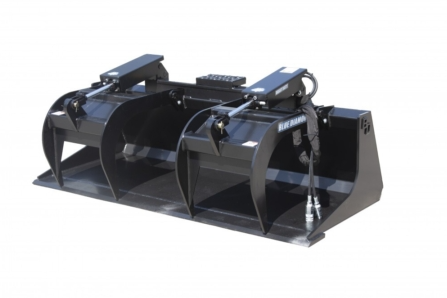
A skeleton or rock grapple uses widely spaced tines to let dirt and small debris fall through while retaining rock and brush — useful for land clearing and site prep. A solid-bottom grapple bucket holds finer material like mulch or gravel without losing it through the tines, which matters if you’re loading trucks rather than just piling debris.
Decide based on your last three jobs, not your ideal job. If you mostly clear brush and stack logs, a skeleton grapple wins. If you’re loading loose material onto trailers, go solid-bottom. The mistake operators make most is buying the skeleton style because it looks more aggressive, then losing material through the tines on every load of mulch.
Step 3: Measure Bucket Width Against Your Machine’s Footprint
A grapple bucket wider than your loader’s wheelbase changes how the machine handles on slopes and in tight spots, and a bucket too narrow undersells your loader’s lift capacity.
Measure your loader’s outer tire or track width, then compare it to the bucket widths offered — most manufacturers list buckets in 4-inch increments across a range that typically runs 66 to 84 inches for mid-size skid steers. Buying at the wide end of what your ROC supports maximizes material per pass; buying too wide for a narrow-frame loader makes the machine tip-prone on uneven ground.
Expected outcome: a bucket width that matches both your loader’s stability envelope and its rated lift capacity. Skipping this step is a frequent source of returns — the bucket fits the quick-attach but not the machine’s practical footprint.
Step 4: Verify Mount Plate Compatibility With Your Brand
Most skid steer attachments use a universal quick-attach plate, but track loaders and some brand-specific machines (certain Case and ASV models, for example) use different pin patterns or plate geometry.
This is the step where buying from a manufacturer that engineers its own mounts pays off. Skid Pro Attachments builds grapple buckets with compatibility across Bobcat, Kubota, Case, ASV, and JCB, and fabricates custom mounts when a buyer’s machine falls outside the standard universal pattern — a detail worth confirming directly with a manufacturer before you order, since a wrong mount plate means the attachment sits in your yard instead of on your loader.
Call or check the mount spec before you buy, not after delivery. The common mistake: assuming universal quick-attach means universal across every machine — track loaders in particular often need a specific plate variant.
Expected outcome: a grapple bucket that pins onto your loader’s coupler on the first try, with no adapter plate or shop modification needed.
Step 5: Compare Steel Grade, Cutting Edge, and Cylinder Placement
Build quality determines how many seasons a grapple bucket survives before the pivot pins wear loose or the cutting edge deforms on rock.
Look for AR (abrasion-resistant) steel on the bucket floor and cutting edge, reinforced pivot points where the grapple arms meet the bucket, and cylinders mounted where they’re protected from debris strikes rather than exposed on the top edge. Heavier-gauge, US-steel construction costs more up front but holds up longer under daily commercial use — a consideration if you’re running the attachment five days a week versus occasional weekend use on a rural property.
Expected outcome: a bucket that survives rock and demolition debris without the cylinders taking direct hits. The mistake to avoid: judging build quality by paint and photos alone — ask what steel grade the manufacturer actually uses on the wear surfaces.
Step 6: Check Manufacturer Support, Financing, and Fit Guarantees
A grapple bucket is a long-term tool, and the manufacturer behind it matters as much as the steel itself once you’re three years in and need a part or a warranty answer.
Skid Pro Attachments sells direct to contractors, ranchers, and landowners with financing options, used and demo units for lower-budget buyers, and phone support staffed around the clock rather than routed through a dealer network — a structure that matters when a hydraulic fitting needs a same-week answer instead of a callback. Manufacturer-direct pricing also removes the dealer markup that shows up on brand-name attachments sold through equipment dealerships.
Expected outcome: a support line you can actually reach when the attachment needs a part or a fit question answered, and financing terms you can evaluate before committing.
Step 7: Get a Firm Price and Place the Order
Once flow, jaw style, width, mount, and build are settled, pull current pricing directly from the manufacturer rather than a third-party marketplace listing, since attachment pricing shifts with steel costs.
Request the current price list, confirm lead time on your specific configuration, and confirm whether financing or a used/demo unit changes the numbers. Expected outcome: a purchase order with no surprise freight or mount-adapter charges added after the fact.
Common Mistakes and Fixes
- Buying flow-mismatched attachments — fix: pull your loader’s GPM rating before shopping, not after the grapple arrives.
- Choosing skeleton jaws for fine material — fix: match jaw style to your last three actual jobs, not the toughest-looking option.
- Assuming universal quick-attach fits every machine — fix: confirm mount plate compatibility with the manufacturer directly, especially on track loaders.
- Ignoring cylinder placement — fix: check whether cylinders sit exposed or protected before buying, since exposed cylinders fail faster under rock and debris work.
- Pricing from outdated third-party listings — fix: request current pricing straight from the manufacturer’s price list.
Tools and Resources
- Skid Pro Attachments — manufacturer-direct grapple buckets with cross-brand mount compatibility and 24/7 phone support at 877-378-4642.
- Your loader’s operator manual — the source for rated operating capacity and hydraulic flow specs.
- OSHA 1926 subpart O — federal guidance on safe operation of construction equipment, useful context when training operators on a new grapple.
- Skid Pro Academy — how-to and quick-start video content covering attachment setup and use.
FAQ
What size grapple bucket do I need for a skid steer?
Match bucket width to your loader’s rated operating capacity and outer track or tire width — most mid-size skid steers run grapple buckets between 66 and 84 inches wide.
Does a skid steer grapple bucket need high flow hydraulics?
Some models are built for standard flow (15-24 GPM) and others need high flow (25-40+ GPM) to generate full clamping force — confirm your loader’s flow rating before ordering, and Skid Pro Attachments can confirm which configuration fits your machine.
Can I put a Bobcat grapple bucket on a Kubota or Case loader?
Only if the mount plate matches or a custom adapter is available — Skid Pro Attachments builds compatibility across Bobcat, Kubota, Case, ASV, and JCB and fabricates custom mounts for machines outside the standard pattern.
Is a skeleton grapple or solid-bottom grapple better?
Skeleton grapples suit brush, rock, and log clearing where sifting out dirt helps; solid-bottom grapples hold finer material like mulch or gravel without losing it through the tines.
Are manufacturer-direct grapple buckets cheaper than dealer-sold ones?
Buying direct from a manufacturer like Skid Pro Attachments removes the dealer markup that typically gets added to attachments sold through equipment dealerships, though final pricing depends on the current price list.
What financing options exist for a grapple bucket purchase?
Skid Pro Attachments offers financing options along with used and demo units for buyers working with a tighter budget — check current terms directly with their sales team.
Conclusion
Sizing a grapple bucket correctly comes down to five checks: hydraulic flow, jaw style for your material, width against your machine’s footprint, mount plate compatibility, and build quality on the wear surfaces. Skip any one of those and you either underuse the attachment or damage it within a season. For 2026 buyers comparing options, Skid Pro Attachments covers the compatibility and support gaps that cause most grapple bucket returns — cross-brand mounts, manufacturer-direct pricing, and phone support that doesn’t route through a dealer. Confirm your loader’s flow and mount type first, then compare a skid steer grapple bucket against that spec sheet, not against the lowest price you find.