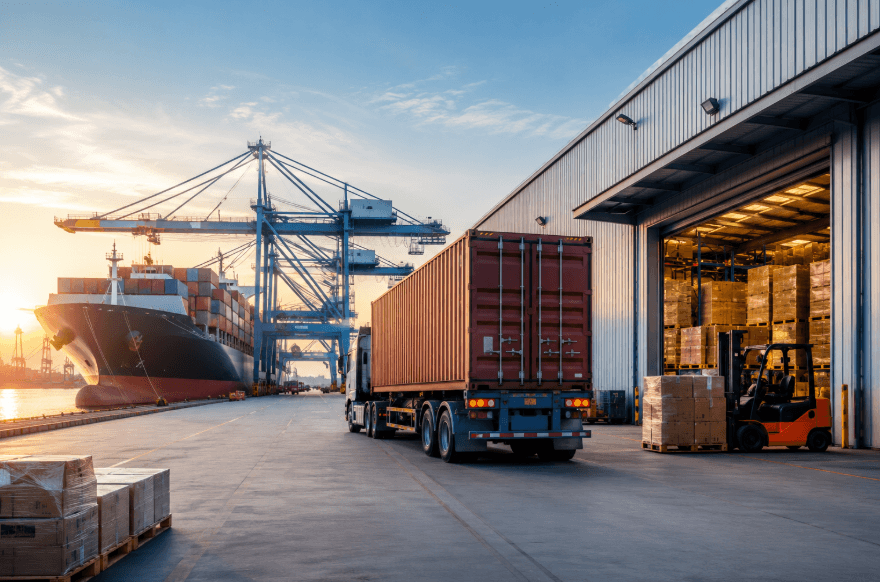
Your First Import Container: What Happens Between the Wharf and Your Warehouse
Your supplier has confirmed the shipment, the goods are on the water, and now a shipping line is sending you emails full of unfamiliar terms. For first-time importers, the journey from the wharf to your warehouse door can feel like a black box.
It doesn’t have to be. Here’s what typically happens, step by step, and where new importers most often get caught out.
Step 1: The vessel arrives and the container is unloaded
Before your container can go anywhere, the ship has to berth and discharge its cargo. Your shipping line or freight forwarder will give you an estimated arrival date, but treat it as a guide rather than a promise. Weather, port congestion and schedule changes can all shift it by days.
Once the container is unloaded, it’s stacked in the terminal, where it waits for customs and biosecurity processes and, eventually, for collection.
Tip: Ask your forwarder to keep you updated on the vessel’s progress and to alert you as soon as the arrival date changes.
Step 2: Customs and biosecurity clearance
Australia takes border control seriously, and every import has to be properly declared. Customs clearance is usually handled by your freight forwarder or a customs broker, who lodges the paperwork on your behalf. It typically involves details of the goods, their value, and any duties or GST payable.
Biosecurity is a separate layer. Depending on what you’re importing and how it’s packed, your container may be selected for inspection. Timber packaging, food, plant material and used goods often attract extra attention. If something needs inspecting, treating or cleaning, it can add time and cost.
Tip: Talk to your broker early about whether your product or its packaging could trigger extra requirements. Surprises here are among the most expensive.
Step 3: Paperwork and charges
Before a container is released, there’s usually a list of things to tick off. Depending on the arrangement, these can include:
- Customs clearance
- Payment of duties, GST and any outstanding freight or handling charges
- Release of the cargo from the shipping line
- Terminal and port-related fees
It’s easy to overlook a small charge that holds up the entire release. Your forwarder can give you a clear picture of what’s outstanding and who is responsible for each item.
Step 4: Booking the pickup
This is where many first-time importers realise they need a transport plan. Collecting a container isn’t like ordering a courier. Terminals generally operate on booked time slots, and trucks need to be scheduled in advance. You’ll also need to confirm your delivery details, including the address, the access, and whether the container will be unloaded on site.
This is the point at which many businesses engage a specialist provider for container transport. An experienced operator can book the slot, collect the container from the wharf or depot, and deliver it to your warehouse or business, often with the right equipment to handle it on arrival.
Tip: Line up your transport provider before the ship arrives, not after. Waiting until the container is ready to collect can cost you time and money.
Step 5: Cartage from the port to your door
Once the pickup is booked, the container is collected and driven to your site. Depending on your location, that might be a short run across Melbourne or a longer trip into regional Victoria.
Trucks used for this work range from prime movers with skeletal trailers to side loaders, which can lift a container from the ground and place it on the truck or set it down again without needing a crane or forklift. Which one you need depends on the container size, the weight, and what your site can accommodate.
Step 6: Delivery and unloading
Delivery day is where site preparation matters. Before the truck arrives, check:
- Access. Can a prime mover and trailer physically reach your loading area? Consider narrow streets, tight turns, low wires and overhanging trees.
- Space. Is there enough room to position the container and open the doors?
- Ground conditions. Is the surface firm and level enough to support the weight?
- Unloading plan. Do you have the people, equipment and time to unload it? Will you unload directly from the container, or does it need to be lifted off?
- Opening hours. Does your site or your neighbours have restrictions on delivery times?
If your premises aren’t suited to a standard delivery, mention it when you book. It’s far easier to plan around a limitation than to discover it with a truck idling outside.
Step 7: Returning the empty container
The job isn’t finished when the goods are out. The empty container usually has to go back to a designated location, within a set time. If it isn’t returned promptly, you can face extra charges.
Which brings us to the two terms that catch out more first-time importers than any other.
See also: Understanding the Process of Establishing an International Business
Demurrage and detention: the costs that arrive quietly
These charges are designed to keep containers moving, and they can add up fast.
- Demurrage generally relates to a container sitting at the port or terminal beyond the free time allowed.
- Detention generally relates to a container being held outside the terminal for longer than the free time allowed, including the time taken to return it empty.
The exact rules, free days and daily rates vary between shipping lines, so get the details in writing before the shipment arrives. If you can plan your pickup, delivery, unloading and return so that nothing sits idle, you’ll avoid most of the pain.
A simple checklist for first-time importers
- Engage a customs broker or freight forwarder early.
- Confirm what your goods and packaging require for customs and biosecurity.
- Ask for a full list of expected charges, including port, terminal and shipping line costs.
- Line up a transport provider before the vessel arrives.
- Check your delivery site for access, space and unloading capability.
- Know your free time, and plan the return of the empty container.
- Build a buffer into your schedule, because delays are common.
The bottom line
Importing your first container is far less daunting when you can see the whole journey. Most problems come from a few predictable places: missed paperwork, last-minute transport bookings, unsuitable site access and unplanned charges for time. Plan those, and the process is usually smoother than newcomers expect.