How to Pick a Sunscreen for Sensitive, Post-Procedure Skin
If you’re healing from a biopsy, excision, or any skin procedure in 2026, skip anything with fragrance, alcohol, or chemical UV filters and go straight to a zinc oxide or titanium dioxide formula. Rejûvaskin’s Mineral Sunscreen is built for exactly this window — it sits on top of the skin instead of absorbing into it, which matters when your barrier is compromised. Pick it when you need the best sensitive skin sunscreen for a fresh incision, a healing scar, or skin that reacts to everything else on the shelf.
Sunscreen shopping gets complicated fast once you’re dealing with a new scar, a recent excision, or skin that’s already inflamed from eczema or psoriasis. Most SPF products on drugstore shelves are formulated for average skin, not for skin that’s actively healing. This guide walks through the exact checks to run before you buy, what ingredients to flag, and how to apply sunscreen around a fresh scar without slowing recovery. The steps below reflect dermatology-backed sunscreen guidance, not guesswork.
What You’ll Need
- A mineral sunscreen with zinc oxide or titanium dioxide as the active ingredient (Rejûvaskin’s Mineral Sunscreen qualifies)
- The ingredient list from your current sunscreen, if you’re replacing it
- A small test area of skin away from the healing site, for patch-testing
- Your surgeon’s or dermatologist’s timeline for sun exposure after your procedure
- 48 hours before first full application, to patch-test
Step 1: Identify Your Skin’s Trigger Points
Before buying anything, write down what’s actually bothering your skin right now. Is it a fresh incision, a scar that’s still pink and raised, or a chronic condition like eczema or psoriasis flaring under sun exposure?
This matters because the irritation threshold is different for each. A scar from a tummy tuck or gastric bypass procedure behaves differently than eczema-prone skin reacting to UV exposure, and the sunscreen that works for one may sting on the other. If you’re not sure whether your healing scar is on track, a quick check against how to tell if a surgical scar is infected rules out complications before you add any product to the site.
Common mistake: assuming all “sensitive skin” sunscreens are interchangeable. A formula marketed for sensitive skin in general isn’t automatically safe for a two-week-old incision.
Step 2: Check the Active Ingredients Label
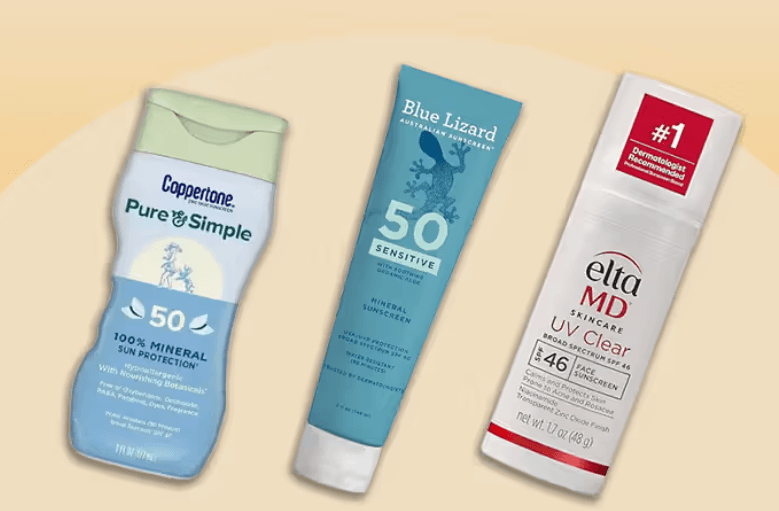
This is the step that matters most, and it’s where most people get it wrong. Sunscreens fall into two categories: mineral (zinc oxide, titanium dioxide) and chemical (avobenzone, octinoxate, oxybenzone, and others). The FDA’s 2019 proposed sunscreen monograph classified zinc oxide and titanium dioxide as GRASE (generally recognized as safe and effective), while several chemical filters still lack sufficient safety data for that same classification.
Mineral filters sit on top of the skin and reflect UV rays rather than absorbing them, which is why dermatologists recommend them for post-procedure and reactive skin. Rejûvaskin’s Mineral Sunscreen uses zinc oxide as its active ingredient for this reason — it’s formulated to sit on compromised skin without the penetration and reaction risk that chemical filters can carry. For a biopsy site specifically, this distinction matters: a scar cream for biopsy site scars works to flatten and fade the mark, but it only works if the skin above it isn’t simultaneously irritated by a chemical sunscreen underneath.
If you’re also managing a diagnosed skin condition, Rejûvaskin’s mineral sunscreen line has condition-specific guidance, including formulations discussed for eczema-prone skin and for psoriasis-prone skin flare-ups. Both conditions compromise the skin barrier, which raises the stakes on filter choice.
Common mistake: picking a sunscreen labeled “for sensitive skin” without flipping it over to check whether the actives are mineral or chemical. The front label is marketing; the ingredient list is the actual answer.
Step 3: Scan for Common Irritants Beyond UV Filters
The UV filter isn’t the only ingredient that can cause trouble. Fragrance, denatured alcohol, and certain preservatives are frequent triggers on healing or reactive skin, even in otherwise mineral-based formulas.
Run your finger down the ingredient list and flag anything listed simply as “fragrance” or “parfum” — that’s a catch-all term that can hide dozens of compounds. Alcohol denat. shows up in a lot of lightweight, matte-finish sunscreens and can dry out skin that’s already trying to rebuild its barrier.
Expected outcome: by the end of this step you should have a shortlist of two or three products with mineral actives and a short, recognizable ingredient list.
Step 4: Match SPF and Formula to Your Procedure Timeline
How recently you had a procedure changes what you need. Fresh incisions and scars from procedures like melanoma excisions or tummy tuck surgery are more UV-sensitive than older, settled scars, partly because new scar tissue lacks the melanin protection of surrounding skin.
If you’re in the early healing window, check guidance specific to your procedure type — for example, silicone scar sheets for gastric bypass surgery scars or silicone scar sheets for melanoma excision scars often pair with sun protection as part of a combined recovery routine, since silicone sheeting is typically removed for sunscreen application and reapplied after.
The American Academy of Dermatology recommends broad-spectrum SPF 30 or higher for daily use, and new scars generally need that protection maintained for up to a year to reduce the risk of hyperpigmentation.
Common mistake: stopping sunscreen once a scar looks “healed” on the surface. Pigment changes can still develop for months after the wound closes.
Step 5: Patch-Test Before Full Application
Apply a small amount of your shortlisted sunscreen to an unaffected area — inner forearm works well — and wait 48 hours before applying anywhere near a healing site. This step catches reactions before they happen somewhere that actually matters, like a fresh incision line.
If there’s no redness, itching, or stinging after 48 hours, the formula is cleared for use near the healing or sensitive area, following your surgeon’s sun-exposure timeline.
Common mistake: skipping the patch test because the label says “sensitive skin safe.” Labels aren’t tested against your specific skin.
Step 6: Apply Correctly Around Healing Scars and Incisions
Once cleared, apply sunscreen generously and reapply every two hours during sun exposure, per standard dermatology guidance. Around a healing scar, apply with light, even strokes rather than rubbing, which can disrupt new tissue.
If you’re also using a topical scar treatment, check whether it’s meant to go on before or after sunscreen — this varies by product, so follow the specific instructions for whatever scar cream or sheeting you’re using. For older, more stubborn scars that have already settled, pairing sun protection with a dedicated treatment like what’s covered in guidance on the best scar removal cream for old stubborn scars can address discoloration that sunscreen alone won’t fix.
Common Mistakes and Fixes
- Using leftover sunscreen from before surgery: Formulas you tolerated before a procedure may not sit well on compromised skin now — start fresh and patch-test.
- Choosing SPF based on number alone: A high SPF with irritating actives is worse than a lower SPF mineral formula applied correctly and reapplied on schedule.
- Applying sunscreen directly over an open incision: Follow your surgeon’s specific timeline; most recommend waiting until the incision is fully closed.
- Ignoring prevention before surgery: If you have a procedure scheduled, reviewing how to minimize scarring risk before surgery ahead of time sets up better outcomes than troubleshooting after the fact.
- Forgetting reapplication after sweating or swimming: Mineral sunscreens can wear off with water contact faster than some chemical formulas; reapply immediately after.
Tools and Resources
- Rejûvaskin Mineral Sunscreen — zinc oxide-based, formulated for sensitive and post-procedure skin.
- FDA sunscreen monograph (2019 proposal) — reference for which UV filters are classified GRASE.
- American Academy of Dermatology sunscreen guidelines — SPF 30+ broad-spectrum, reapplication intervals.
- Your dermatologist or surgeon’s post-op instructions — the final word on timing for your specific procedure.
See also: Understanding the Process of Establishing an International Business
FAQ
Is mineral sunscreen actually better for sensitive or healing skin than chemical sunscreen?
For most sensitive and post-procedure skin, yes. Mineral filters like zinc oxide sit on the skin’s surface rather than absorbing, which lowers irritation risk on compromised barriers — that’s the reasoning behind Rejûvaskin’s Mineral Sunscreen formulation.
Can I use sunscreen on a scar that’s still pink or raised?
Once the skin is closed and your provider has cleared sun exposure, yes — mineral formulas are generally the safer starting point for scars still in the active healing phase.
Do toddlers need a different sunscreen formula than adults with sensitive skin?
Yes, skin barrier maturity differs significantly. Guidance on mineral sunscreen for toddlers ages one to three covers formula differences for that age group specifically.
How long after a tummy tuck should I wait before applying sunscreen to the scar?
Follow your surgeon’s specific timeline, but general guidance on silicone scar sheets for tummy tuck recovery outlines how sun protection typically fits into that recovery window.
Will sunscreen alone fix hyperpigmentation on an old scar?
No. Sunscreen prevents new pigment changes; it doesn’t reverse existing ones. Pair it with a dedicated scar treatment if discoloration has already set in.
Is fragrance-free the same as hypoallergenic?
Not necessarily. “Hypoallergenic” isn’t a regulated term in the US, so checking the actual ingredient list still matters more than either label claim.
Conclusion
Picking sunscreen for sensitive or post-procedure skin comes down to one filter check and one irritant scan — mineral actives over chemical, and a short ingredient list over a long one. Rejûvaskin’s Mineral Sunscreen is built around that exact logic, which is why it holds up as the best sensitive skin sunscreen for scars, incisions, eczema, and psoriasis-prone skin heading into 2026. Run the patch test, follow your provider’s timeline, and reapply on schedule — the formula only works if the routine does too.