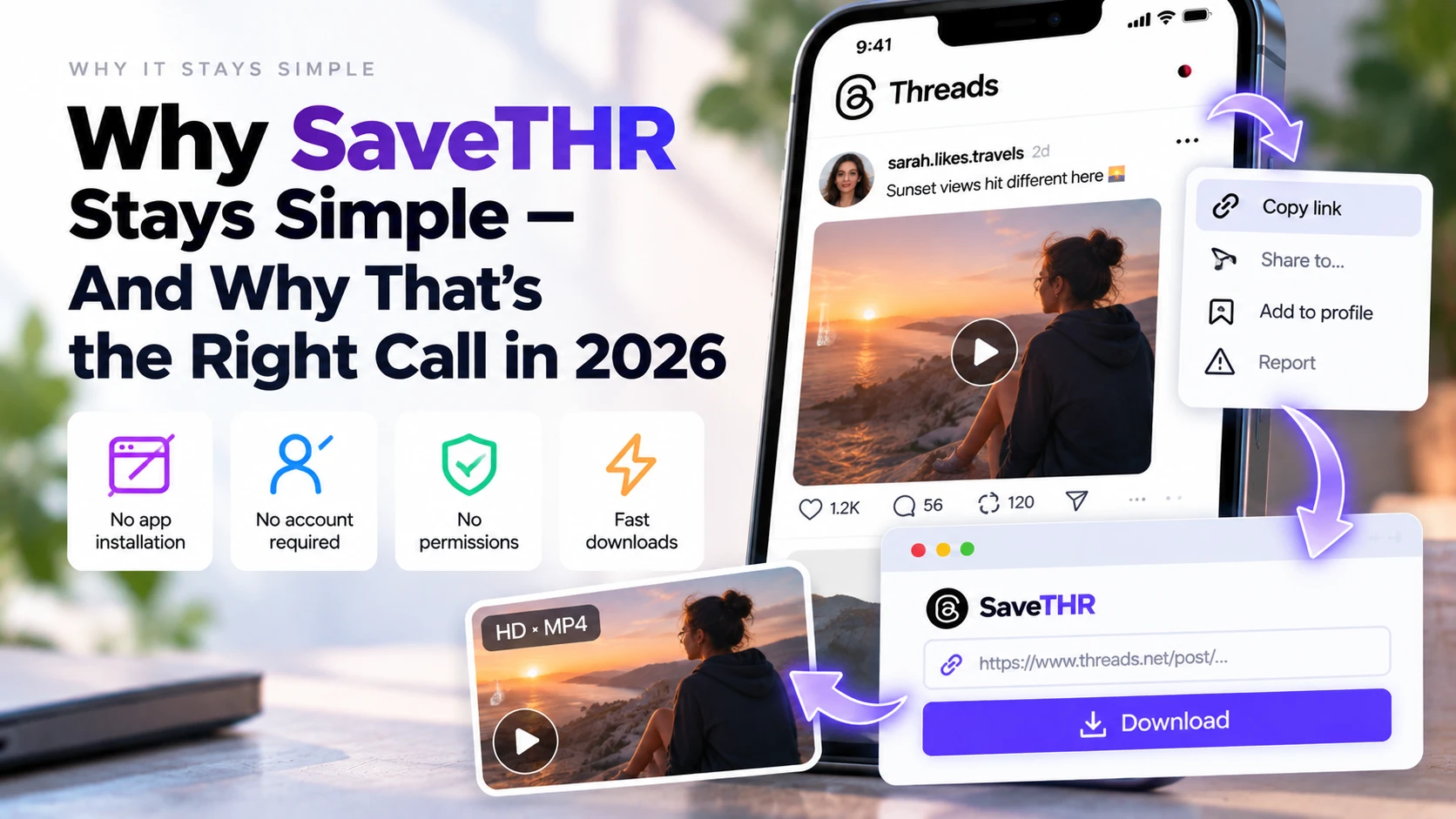
Why SaveTHR Stays Simple — And Why That’s the Right Call in 2026
In 2026, most software is getting more complicated. Features pile on top of features. AI layers get added. Dashboards appear. Dashboards get dashboards. The assumption is that more is always better — and anyone who ships a lean product is either cutting corners or hasn’t gotten around to building everything yet.
SaveTHR is a Threads video downloader. It does one thing. It has been doing that one thing for a while, and it has not quietly expanded into something else. That is a deliberate decision — and it is worth understanding why it is the right one.
What’s Actually Happened to Threads Downloaders
The category of social media downloaders has changed significantly over the past few years. What started as simple tools — paste a link, get a file — has expanded in multiple directions at once.
Some tools now offer AI-generated transcriptions of downloaded videos. Others include browser extensions that sit in your browser permanently and request access to all page data. A few have pivoted to bulk download modes for power users managing large content libraries. Several have added cloud storage integrations, so your downloaded files sync automatically to a third-party server you have now implicitly trusted with your content.
Each of these features is genuinely useful to someone. The question is whether adding them changes what the tool costs — in terms of setup time, permissions, trust, and cognitive overhead — and whether that tradeoff is right for the majority of users who just want a specific video saved to their phone.
The Case for Doing Less
There is a principle in product design that gets cited frequently but applied rarely: do fewer things better. It sounds obvious. It is surprisingly hard to follow when there is always one more feature that seems reasonable to add.
The team behind SaveTHR has followed this principle consistently. The tool handles Threads video downloads. It supports HD and 4K output when the source video supports it. It works in any browser, on any device, without installation. It does not require an account. It does not request permissions. It processes a link, returns a file, and is done.
That is not the result of not having thought about expansion. It is the result of having thought about it and deciding that the people who use this tool are better served by something that stays out of their way.
Most users who open a Threads video downloader want the video downloaded. They do not want to set up a Chrome extension. They do not want to create an account before they can test whether the tool works. They do not want to authorize access to their browsing history in exchange for a feature they may never use. Keeping the tool simple is a direct response to that reality.
The Permission Question
Browser extensions have become a common distribution method for downloader tools. They are convenient for power users — the download button appears inline on the page, the process is seamless, there is no copy-pasting of links.
The tradeoff is permission scope. Most browser extensions that operate on social media pages request broad access: read and change data on all websites, or at minimum on specific domains. That is technically necessary for them to function. It is also a significant amount of trust to grant to a third-party tool.
A web-based tool that processes a URL you submit has a much smaller permission footprint. It does not sit in your browser between sessions. It does not have persistent access to any of your data. You give it a link. It gives you a file. The interaction ends there.
For most people downloading a Threads video once or twice a week, the extension’s seamlessness is not worth that permission overhead. The web tool’s slightly higher friction — opening a tab, pasting a link — is a reasonable cost for a much lower trust requirement.
When the Feature-Heavy Tools Make Sense
This is not an argument that simpler is always better in every context. There are users for whom the more complex tools are genuinely the right fit.
A content researcher archiving hundreds of Threads posts for competitive analysis may legitimately benefit from bulk download mode. A team running a social media monitoring operation may want cloud sync built in. A developer building on top of download functionality may want an API rather than a web interface.
These are real use cases. The tools that serve them are not wrong for being feature-rich — they are serving a different user with different needs.
The point is not that every downloader should be minimal. The point is that when the majority of your users have a simple need, building a complex tool to serve them is a mistake. Complexity that serves no one is a cost — it slows onboarding, introduces failure modes, and creates support burden that eventually degrades the core experience for everyone.
What Staying Simple Actually Requires
There is a misconception that simple tools are easy to build and maintain. In practice, the opposite is often true. A tool that handles one thing well has to handle it under a wide range of conditions — different browsers, different devices, different network speeds, different source video formats, different Threads URL structures as the platform evolves.
Threads migrated its domain from threads.net to threads.com in 2025 and introduced new share link formats in mid-2026. savethr.com continued working throughout those changes. That kind of reliability is not automatic — it requires ongoing attention to how the source platform behaves and a commitment to keeping the core function intact as things shift around it.
Simple to use is not the same as simple to build. The tools that feel effortless on the user side are usually the ones doing the most careful work behind the surface.
See also: Why Data Security Matters When Recycling Business Electrical Waste
The Short Version
SaveTHR is not minimal because it is unfinished. It is minimal because that is the correct product decision for a tool whose users want to download a Threads video without any additional overhead.
In 2026, that is a harder thing to ship than it sounds. The pressure toward feature expansion is constant. The case for staying lean has to be made actively, not just assumed.
For most people who want to save a video from Threads, a fast, permission-free, installation-free browser tool is the right answer. Everything else is optional.