From White Cube to Stone Church: Picking an Art Gallery Room for a New Series
A new series can change character before a visitor studies a single work. Wall colour, floor material, ceiling height and architectural detail affect how the sequence is first perceived. On Exhibily, artists and galleries can choose between four virtual rooms and walk through them before deciding where the work should hang. The browser-based art gallery is a 360° virtual exhibition space rather than a physical venue with an address or visiting hours.
That makes the room part of the curatorial decision. Exhibily offers Modern, Classic, Industrial and Church settings, each with a visibly different atmosphere. A useful starting point is to enter the rooms first, look at the walls and architecture as a visitor would, then judge which setting supports the series without competing with it.
What changes from Modern to Church?
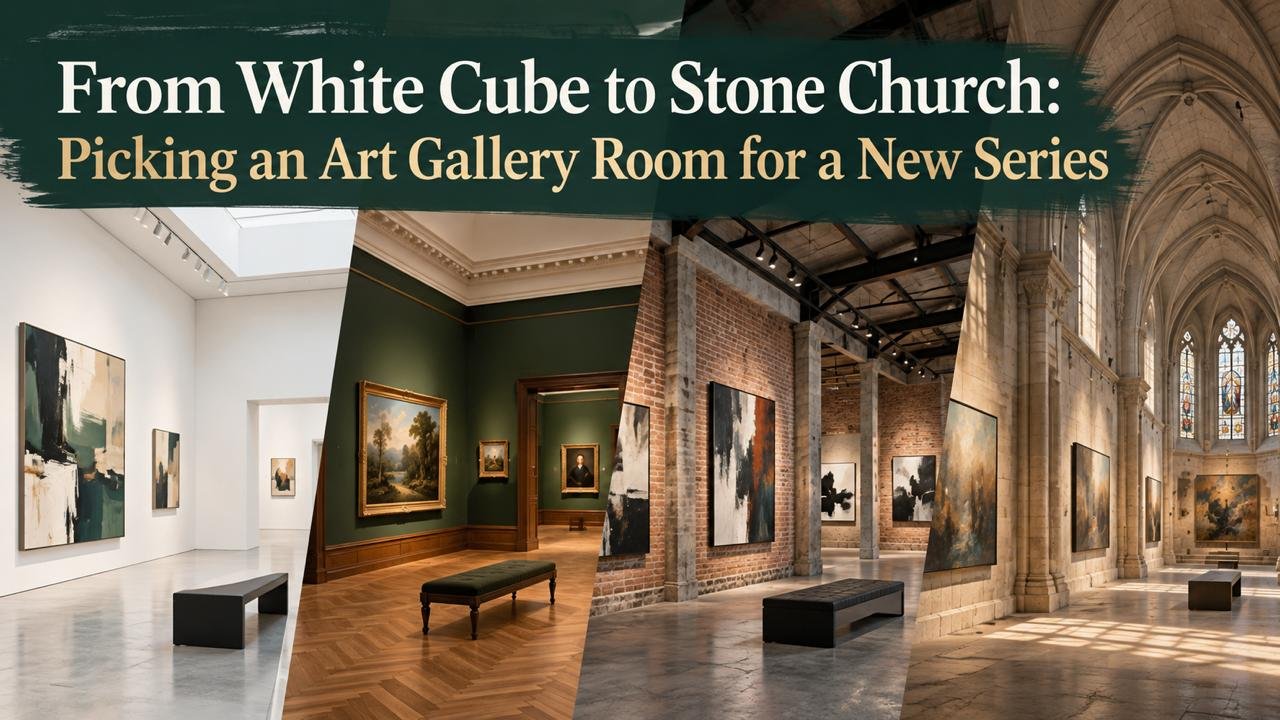
The four rooms differ most clearly in architectural language. Modern is closest to the familiar white-cube idea. Classic introduces the cues of a museum room. Industrial uses brick, concrete and exposed structural details. Church places the work inside a stone hall with columns and a ribbed vault.
| Room | Verified visual character | What to inspect during the walkthrough |
| Modern | White walls, even light and a pale floor | How strongly the works stand apart from the neutral room |
| Classic | Oak parquet, warm coloured walls, panelling and a cornice | How the series sits beside museum-like details |
| Industrial | Brick and concrete beneath a high roof with steel beams and track lights | Whether the rougher materials reinforce or distract from the work |
| Church | A stone nave with two aisles, columns, a ribbed vault, stained glass and an apse | How the stronger architecture changes the rhythm of viewing |
Modern keeps the room visually quiet
Exhibily describes Modern through white walls, even light and a pale floor, with the work taking the lead. For a series that depends on colour relationships, subtle surface changes or a precise sequence, that restrained environment gives the artist fewer architectural signals to manage. The point is not that a neutral room is automatically correct, but that its background is intentionally quiet.
Classic adds museum-like warmth
Classic uses oak parquet, warm coloured walls, panelling and a cornice. Exhibily explicitly likens it to a museum room. That shifts the context from neutral display toward a more established interior language. During the walkthrough, it is worth watching how the wall colour sits beside the dominant tones of the series and whether the architectural details support the hanging.
Industrial gives the background more texture
Industrial is defined by brick and concrete under a high roof with steel beams and track lights. Compared with Modern and Classic, its materials are more visibly present. Walk the room at visitor level and check several viewpoints, because brick, concrete and structural beams remain part of the wider field of view around the works.
Church makes architecture part of the encounter
Church is the most architecturally assertive option. Exhibily describes a stone hall church with a nave and two aisles, columns rising to a ribbed vault, stained glass above the works and an apse at the far end. Those features create a pronounced sense of direction and scale.
This room is worth evaluating as a spatial experience rather than from a single image. Move through the nave, look across the aisles and notice how the long view toward the apse changes the sequence. The choice should come from how the series behaves inside the room, not from the room name alone.
Why should you walk through the rooms first?
Exhibily lets creators walk through the available space before making the room choice. That matters because the platform can hang works at the dimensions entered for them, allowing differences in scale to remain visible. A large work and a smaller work do not have to collapse into equal-sized thumbnails.
Room selection therefore affects more than the background. It frames scale, pacing and the transitions between works. Once the exhibition is prepared, visitors can move through the 360° room in a browser and open individual works for more detail. They can also send an inquiry to the artist directly.
A virtual room can extend a physical exhibition
Exhibily’s guide makes an important distinction: an online exhibition is not presented as a replacement for a physical exhibition, but as a way to complete and extend it. A series can be arranged as a walk-through digital experience for people who are not standing in the physical room.
That complementary role also changes how an exhibition can be shared. Exhibily provides invitation and social media images for exhibitions, giving artists and galleries material for directing visitors to the online room. The useful decision comes earlier: walk through Modern, Classic, Industrial and Church, then select the room in which the series reads most coherently from work to work.