What Happens to Stem Cells After Storage? A Look Inside the Cryopreservation Process
Preserving your baby’s stem cells is like investing in an asset with a long-term payoff. However, many parents still do not fully understand what happens to stored umbilical cord blood and whether it can actually be safely used decades after extraction. We understand you have similar questions too about stem cell banking and want to know whether they truly last? Or deteriorate and lose their potency with age? Today we will lay all your doubts to rest, so let’s get started.
The Process of Stem Cell Banking
By now, you are probably familiar with how stem cells are extracted from the clamped umbilical cord. A whole new journey of storage and preservation begins after that. After biobanks receive the collection kit containing cord blood, they start preparing it for storage and that involves two distinct stages:
- Cell separation: Cord blood is not only rich in stem cells, but it contains other cells too – namely, red blood cells, plasma, and white blood cells. Isolating Hematopoietic Stem Cells (HSCs) and Mesenchymal Stem Cells (MSCs) from these is a necessary step in preservation as the presence of excess red blood cells can cause toxicity upon thawing.
- Adding cryoprotectant: Isolated raw cells cannot simply be put into cold storage and frozen. That’s not how it works. The water inside them is bound to turn into ice crystals and destroy the stem cells within. To prevent this from happening, a specialized cryoprotectant solution is introduced into the container to serve as a safe anti-freezing agent.
After this, stem cells are stored in controlled-rate freezers with their temperatures dropping 1°C to 2°C per minute until they reach a temperature of -80°C to -90°C. This gradual cooling preserves the integrity of the cells.
Understanding The Lifecycle of Stored Stem Cells
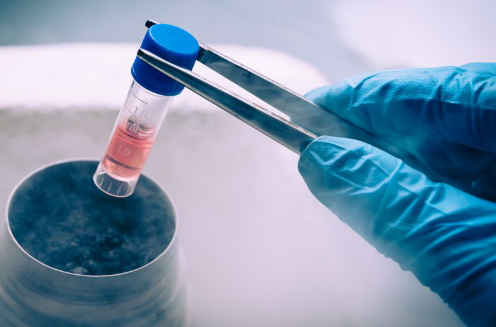
Long-term storage tanks are filled with vapour-phase liquid nitrogen with their temperatures ranging from -150°C to -196°C. This ultra-cold preservation technique completely eliminates the risk of cross-contamination.
The major advantage of maintaining such low storage temperatures is that it halts the biological clock of preserved stem cells. That means do not age or experience metabolic, enzymatic, and biochemical reactions. Think of them as being frozen in time as that is exactly what happens to them. There is simply no degradation or biological ageing even if your baby accesses it 25 years from now.
In fact, studies back this up. So if you are wondering if stem cells will hold up 20 years from now, there is strong evidence to suggest that they will. Take for example, the long-term analysis research published by Parent’s Guide To Cord Blood Foundation. It confirms the long-term viability of stored stem cells. As per their research, cryopreserved stem cells retain high recovery rates and membrane integrity if stored in a cryogenic facility continuously.
As for transplant efficiency after decades of storage, there is evidence for that too. A landmark clinical trial published in the journal Oxford Academic demonstrated the effectiveness of stored cord blood stem cells even after 27 years of storage. The researchers of this study proved that thawed stem cells maintained normal recovery rates. In fact, they were successfully engrafted in vivo, thus proving that deep storage virtually had no impact on their therapeutic properties. That’s a major, major win!
That’s enough evidence to prove that parents who opt for community stem cell banking services from reputable banks not only enjoy benefits such as high donor match, access to a wider library of compatible units and family coverage plans; but that they also get peace of mind that their units will be safely preserved.
Thawing & Release Protocol
Knowing about how stem cells are stored is just as important as understanding the release and thawing protocol that surrounds them. If your family ever comes to require them for a medical emergency, you will have to apply for retrieval. The good news is that trustworthy banks carry out this process with the utmost precision.
Generally, biobanks coordinate directly with the hospital where the transplant will take place. Requested samples are stored and shipped at the required temperature in a validated dry vapor shipper to ensure the units preserve their integrity. Once they arrive at the transplant center, they are rapidly thawed in specialized vapour baths till they reach a temperature 37°C. Post that, their viability is checked so they can be safely transplanted.
Conclusion
Stem cell banking might still be a relatively new form of therapy but it is a very effective and safe one. Parents who choose community cord blood banking, in particular, can be rest assured that they will get to reap all the benefits that come with it along with extended lifespan. This truly ensures complete peace of mind and inspires confidence in the value of their investment.