Why Data Security Matters When Recycling Business Electrical Waste
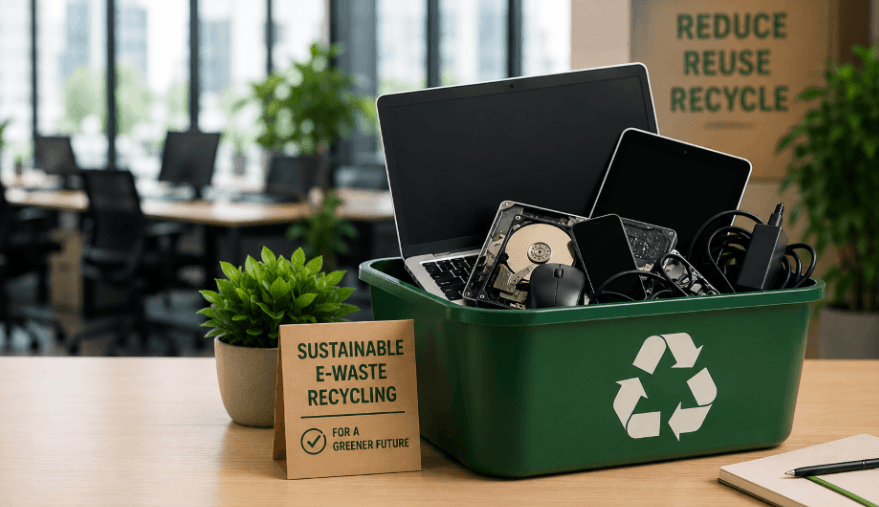
When a business retires laptops, servers, networking equipment, mobile devices, or industrial electronics, the visible hardware is only part of what leaves the premises. Stored inside may be customer records, employee information, financial documents, credentials, intellectual property, and configuration data that could provide access to company systems.
That makes electrical waste recycling more than an environmental or facilities-management task. It is also an information security process. Businesses need a disposal workflow that protects sensitive data, documents the transfer of equipment, and recovers the value of recyclable materials responsibly.
Discarded Electronics Can Still Hold Valuable Data
A device does not become harmless simply because it is obsolete, damaged, or no longer connected to the company network. Hard drives and solid-state drives may retain recoverable files. Smartphones can contain cached emails and authentication tokens, while printers and multifunction devices may store scanned documents, address books, and network settings.
Less obvious equipment can create risks as well. Routers, firewalls, access-control systems, point-of-sale terminals, and industrial controllers may contain credentials or configuration details. Even a failed device can sometimes be repaired sufficiently to retrieve its stored information.
The consequences of careless disposal can be significant:
- Exposure of personal, financial, or commercially sensitive information
- Loss of intellectual property and confidential business records
- Regulatory investigations, contractual disputes, or notification costs
- Unauthorized access enabled by stored passwords or network configurations
- Reputational damage among customers, employees, and partners
These risks explain why electrical and electronic equipment waste (ser jäte) should be governed by a formal process rather than placed in a general scrap container or handed to an undocumented collector.
Start With an Accurate Asset Inventory
Secure recycling begins before equipment leaves the workplace. Create an inventory that records the asset type, serial number, internal asset tag, storage-media status, department, and person authorizing disposal. For large collections, barcode scanning can reduce manual errors and make reconciliation easier.
Next, classify assets according to data sensitivity. A monitor generally presents a different information risk from a finance department laptop, backup appliance, or server. Classification helps determine whether a device needs logical sanitization, physical media destruction, or additional approval before release.
Do not overlook equipment stored in cabinets, warehouses, or remote offices. Forgotten devices often sit outside normal asset-management controls, yet they may contain older records that remain confidential. A scheduled review of storage areas can reduce this hidden exposure while freeing valuable space.
Choose the Right Data Sanitization Method
Deleting files, emptying a recycle bin, or performing a quick reformat may remove references to information without making the underlying data unrecoverable. The appropriate sanitization method depends on the storage technology, condition of the device, sensitivity of the information, and whether the equipment will be reused or dismantled.
Logical Erasure
Verified data-erasure software may be suitable for functional drives intended for reuse. The process should follow an established internal or recognized sanitization standard, generate a result for each device, and flag failures for separate treatment. Verification matters: a completed command is not the same as proof that every target area was sanitized successfully.
Cryptographic Erasure
For properly encrypted media, destroying the relevant encryption keys can make stored information inaccessible. However, businesses must confirm that encryption covered the entire device and that key management was sound throughout its use. Cryptographic erasure should not be assumed merely because a login password was enabled.
Physical Destruction
Damaged, inaccessible, or highly sensitive media may require physical destruction. The method should render the data-bearing components impractical to reconstruct and should be documented. Removing and destroying storage media does not mean the rest of the device must be wasted: circuit boards, cables, housings, and non-ferrous metals can still enter appropriate recycling streams.
Protect the Chain of Custody
Even effective sanitization can be undermined by poor handling. Equipment left in an unlocked hallway, loading bay, or open skip may disappear before processing. A secure chain of custody therefore needs controlled collection areas, named personnel, documented handovers, suitable transport, and reconciliation at the receiving location.
Before selecting a recycling partner, ask practical questions:
- How are collections scheduled, recorded, and transported?
- Are loads weighed, categorized, and reconciled on arrival?
- How are circuit boards and other valuable fractions evaluated?
- What documentation is available for transactions and processing?
- How are discrepancies, rejected items, or suspected hazardous components handled?
- Which data-destruction responsibilities belong to the customer, and which belong to a specialist provider?
That final question is essential. A metal or PCB recycling service should not automatically be treated as a data-destruction service. Responsibilities must be agreed in advance, and sensitive media should remain under appropriate control until sanitization or destruction has been verified.
Security and Material Recovery Work Together
Once data risks have been addressed, retired electronics should be viewed as recoverable resources rather than ordinary rubbish. Printed circuit boards can contain copper and small concentrations of precious metals, while equipment may also yield aluminium, brass, and other non-ferrous materials. Separating these fractions supports more accurate evaluation and reduces unnecessary loss of value.
Metalaxis brings specialist purchasing and recycling expertise to printed circuit boards and non-ferrous scrap in Finland. Its detailed evaluation approach helps businesses understand the material value within properly prepared electronics. Rather than allowing mixed equipment to accumulate without records or a plan, organizations can integrate secure retirement with a transparent recovery process.
For mixed electrical scrap (sähköromu), businesses should separate data-bearing media, batteries, circuit boards, cables, and metal fractions where safe and operationally practical. Never dismantle hazardous or unfamiliar equipment without suitable training, tools, and protective measures. A recycling specialist can advise how materials should be sorted for efficient assessment and responsible onward processing.
Create a Repeatable Offboarding Policy
A dependable policy should define who approves disposal, who performs or verifies sanitization, where retired assets are stored, which records must be retained, and when the recycling partner takes custody. It should also establish procedures for leased equipment, employee-owned devices, remote locations, and emergency disposal after hardware failure.
Training is equally important. Employees need to know that obsolete electronics must not be taken home, donated informally, or discarded in general waste. Procurement, IT, security, facilities, legal, and finance teams should share clear responsibilities instead of assuming another department has handled the risk.
Businesses can test the process with a small batch before arranging a larger collection. Compare the asset register with received-item records, review sanitization evidence, confirm payment and material classifications, and investigate discrepancies. If your company has electronics waiting in storage, now is a good time to inventory them, isolate data-bearing components, and ask Metalaxis about PCB evaluation and suitable recycling preparation.
Responsible Recycling Is Part of Information Governance
Electrical waste management is often discussed in terms of storage space, environmental responsibility, and raw-material recovery. Those benefits are important, but the information stored on retired equipment can be more valuable—and more damaging in the wrong hands—than the hardware itself.
By combining asset tracking, verified sanitization, controlled custody, clear documentation, and expert material evaluation, organizations can reduce data exposure while recovering value from end-of-life electronics. The result is not merely a cleaner storeroom. It is a defensible, repeatable process that supports security, sustainability, and sound financial management at the same time.