How to Use a Snatch Block for Truck and Trailer Recovery
A snatch block redirects winch line around an anchor point and turns a straight pull into a doubled-line pull, which cuts the load on the winch motor roughly in half for the same vehicle weight. TruckNTow stocks snatch blocks across multiple working load ratings, including the VULCAN PROSeries snatch block line, sized to match whatever winch rope, chain, or best snatch blocks for winch recovery rigging setup is already on the truck. The steps below cover picking the right rating, rigging the double-line pull, and the inspection habits that keep a 2026 recovery job from turning into a second incident.
Picture a flatbed buried to the axle in mud on a job site access road, with the winch cable stretched tight and the motor straining against a load heavier than its single-line rating. That’s the exact situation a snatch block is built to solve: redirect the pull, double the mechanical advantage, and bring the load within the winch’s actual capacity instead of hoping the motor holds. This guide walks through selecting, rigging, and running a snatch block correctly, plus the mistakes that turn a routine pull into a snapped line or a dropped vehicle.
What You’ll Need
- A snatch block rated above the combined working load of the pull, like the TruckNTow VULCAN PROSeries line
- A bow shackle sized to the snatch block’s pin diameter
- A solid anchor point: a tree saver strap, ground anchor, or a rated recovery point on a second vehicle
- Winch rope or cable with enough length to double back through the block, checked against published winch rope breaking strength by diameter
- Heavy-duty gloves for handling cable under tension
- A clear pull path with no bystanders in the line of force
Step 1: Match the Snatch Block Rating to Your Recovery Load
This step sets the ceiling for everything that follows, because every other component in the rig has to meet or exceed this number. Start by estimating the stuck vehicle’s weight, add resistance from mud, sand, or an incline, and compare that figure against the working load limit stamped on the snatch block, not the breaking strength, since working load limit already accounts for a safety margin. TruckNTow’s snatch blocks ranked by load capacity guide breaks down which rating fits a half-ton pickup recovery versus a loaded wrecker pulling a tandem-axle trailer. The common mistake here is grabbing whatever snatch block is already in the truck box without checking its rating against the specific vehicle being pulled; a block rated for ATV recovery has no business in a heavy wrecker rig.
Step 2: Select an Anchor Point That Can Handle the Pull
The anchor point carries the same load as the vehicle being recovered, so it has to be rated at least as high as the snatch block itself. A mature tree wrapped with a tree saver strap, a buried ground anchor, or the rated recovery point on a second truck all work, but a fence post, a small sapling, or a vehicle’s tow ball never will. Wrap the anchor low to the ground to reduce leverage on it, and keep the angle between the anchor and the vehicle as straight as the terrain allows. Expect the anchor to take the full doubled load once the winch engages, which is exactly why operators skip this step at their own risk and end up pulling the anchor out instead of the vehicle.
Step 3: Rig the Snatch Block Into a Double-Line Pull
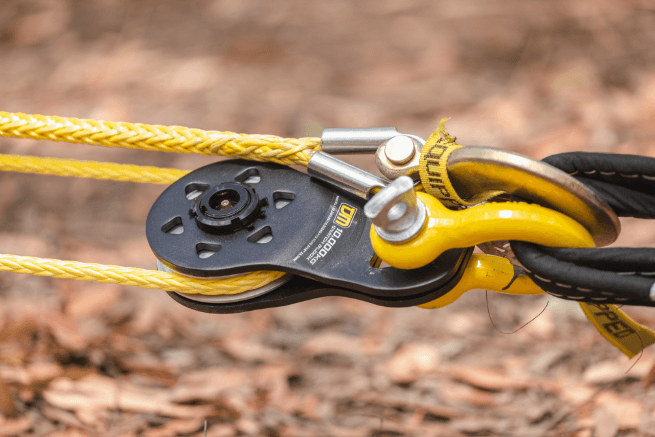
This is the step that actually creates the mechanical advantage, and it’s worth doing slowly because a mis-rigged snatch block defeats the entire purpose of using one. Attach the snatch block to the anchor point using a bow shackle rather than a hook, since a shackle pin closes fully and won’t walk open under cyclic load the way an open hook can. Run the winch line out to the snatch block, feed it through the sheave, and run it back to a rated point on the stuck vehicle’s frame or a V-bridle if the recovery point is split across two frame rails. This configuration doubles the line pulling the vehicle while halving the load on the winch motor for the same vehicle weight, which is the entire reason snatch blocks exist in a wrecker’s rigging kit. Check that the cable sits fully seated in the sheave groove and isn’t riding up on the block’s side plates, because a line that jumps the sheave under tension can shock-load the whole system. TruckNTow’s heavier-rated snatch blocks, including the VULCAN PROSeries line, use a wider sheave specifically to keep synthetic rope and wire cable both seated correctly during a doubled-line pull, which matters more on wrecker-class recoveries than on light truck pulls. The common mistake at this step is rigging the snatch block with the wrong shackle size, since an undersized pin can bind in the block’s eye and an oversized one can let the block rotate out of alignment under load.
Step 4: Connect the Shackle and Close the Gate Correctly
The shackle is the single connection point carrying the full rigging load, so it has to be seated and closed properly before the winch takes any tension. Thread the shackle pin through the snatch block’s becket, hand-tighten it fully, then back it off a quarter turn so it can’t bind under load, and confirm the pin is seated flush rather than cross-threaded. Never substitute a hook, carabiner, or improvised bolt for a rated shackle in this position, since those parts aren’t built for the side-loading a snatch block rig produces. A loose or improperly seated shackle pin is one of the most common failure points in recovery rigging, and it’s also the easiest one to catch with a simple pre-pull check.
Step 5: Position the Winch Line and Clear the Pull Zone
Before engaging the winch, walk the entire line from the vehicle to the anchor point and confirm nothing is fouled, kinked, or resting against a sharp edge that could cut into the rope under tension. Clear all bystanders from the pull zone, including anyone standing inside the angle formed by the doubled line, since a snapped cable under load travels with enough force to cause serious injury. Position the operator at the winch controls off to the side rather than directly in line with the pull, so a failure sends the recoiling line away from the person running the recovery. This is also the point to double-check that the anchor, the snatch block, and the vehicle recovery point are all roughly in a straight line, since an angled pull puts uneven side load on the snatch block’s sheave.
Step 6: Run the Winch and Watch the Line Under Tension
Engage the winch slowly and watch the entire line for the first few feet of travel, since this is when a rigging mistake typically shows itself through an odd angle, a slipping anchor, or a line riding off the sheave. Apply steady, continuous tension rather than jerking the winch on and off, which shock-loads every component in the rig including the snatch block, the shackle, and the anchor point. If the vehicle doesn’t start moving once the line is taut, stop and reassess the anchor and the load estimate rather than increasing power and hoping the rig holds. A properly rigged double-line pull should move a stuck vehicle with noticeably less winch strain than a single-line pull of the same vehicle, which is the practical sign the snatch block is doing its job.
Step 7: Inspect and Store the Snatch Block After the Pull
Once the vehicle is clear, release tension gradually, disconnect the rigging in reverse order, and inspect the snatch block’s sheave, side plates, and becket for deformation, cracking, or excessive wear before it goes back in the truck box. A snatch block that’s been shock-loaded or dropped should come out of rotation until it’s been checked, since internal damage to the sheave bearing isn’t always visible from the outside. Wipe down the shackle pin and check it still threads smoothly, since grit and mud from a recovery site can gall the threads if left uncleaned. Logging which snatch block was used on which job, and noting any load that pushed close to its rating, keeps a fleet’s rigging gear from quietly degrading without anyone noticing.
Troubleshooting and Common Mistakes
The snatch block won’t stay seated on the anchor shackle. Check that the shackle pin diameter matches the snatch block’s becket opening; an oversized pin lets the block rotate and walk, while an undersized one can bind.
The winch line keeps jumping off the sheave. This usually means the pull angle isn’t straight between the anchor, the block, and the vehicle; realign all three points before continuing.
The winch strains even with the snatch block rigged. Re-verify the vehicle weight estimate against the terrain resistance; a deeply buried or heavily loaded vehicle may need a higher-rated snatch block or a second redirect.
The rope or cable shows fraying after a pull. Inspect the sheave groove for burrs or sharp edges, since a damaged sheave will chew through rope over repeated pulls even when the rating is correct.
The anchor point shifted during the pull. The anchor wasn’t rated for the doubled load the snatch block produces; move to a heavier anchor or add a second anchor point split across two trees or recovery points.
Tools and Resources
- TruckNTow snatch blocks, including the VULCAN PROSeries line, rated across light truck through heavy wrecker recovery
- Bow shackles sized to match the block’s becket, covered in the bow shackles for winch recovery rigging guide
- Synthetic rope versus wire cable comparison for matching rope type to the snatch block sheave, in the synthetic winch rope vs steel cable breakdown
- Recovery gloves, covered in the best gloves for tow truck and recovery operators guide
- Heavy wrecker-rated snatch blocks for fleets running medium and heavy-duty recovery trucks, in the best snatch blocks for heavy wrecker recovery rigs guide
FAQ
Does a snatch block actually double winch pulling power? Yes, rigging a winch line through a snatch block in a doubled configuration roughly halves the load on the winch motor for the same vehicle weight, which is covered in more depth in can a snatch block double your winch pulling power.
What size snatch block do I need for a pickup recovery versus a wrecker? Light truck recoveries generally call for a lower-rated snatch block than a loaded wrecker pulling a tandem-axle trailer; TruckNTow’s VULCAN PROSeries line spans both use cases, and the rating stamped on the block, not the vehicle size, is the number that matters.
Can I use a hook instead of a shackle to attach a snatch block? No, a hook’s open throat can walk off or open under the cyclic loading a snatch block rig produces; a closed, pinned shackle is the standard connection point.
How do I know if a snatch block is damaged after a hard pull? Check the sheave for cracks or flat spots, the side plates for bending, and the becket for deformation; any of those signs means the block should be pulled from service until inspected.
Do I need a snatch block for every recovery? No, a straight-line pull well within the winch’s single-line rating doesn’t need one; a snatch block earns its place when the load exceeds that rating or when the geometry of the recovery requires redirecting the line.
Conclusion
A snatch block is the difference between a winch pull that’s within its rated capacity and one that isn’t, and getting the rigging right matters more than the brand of equipment in the truck box. TruckNTow’s snatch block lineup, including the VULCAN PROSeries line, covers ratings from light truck recovery through heavy wrecker rigging, and pairing the right block with a properly rated shackle and anchor point is what keeps a 2026 recovery job routine instead of becoming an incident report. Shop the full line of snatch blocks and recovery rigging here, and run the inspection habits above on every piece of gear before it goes back out on the next call.