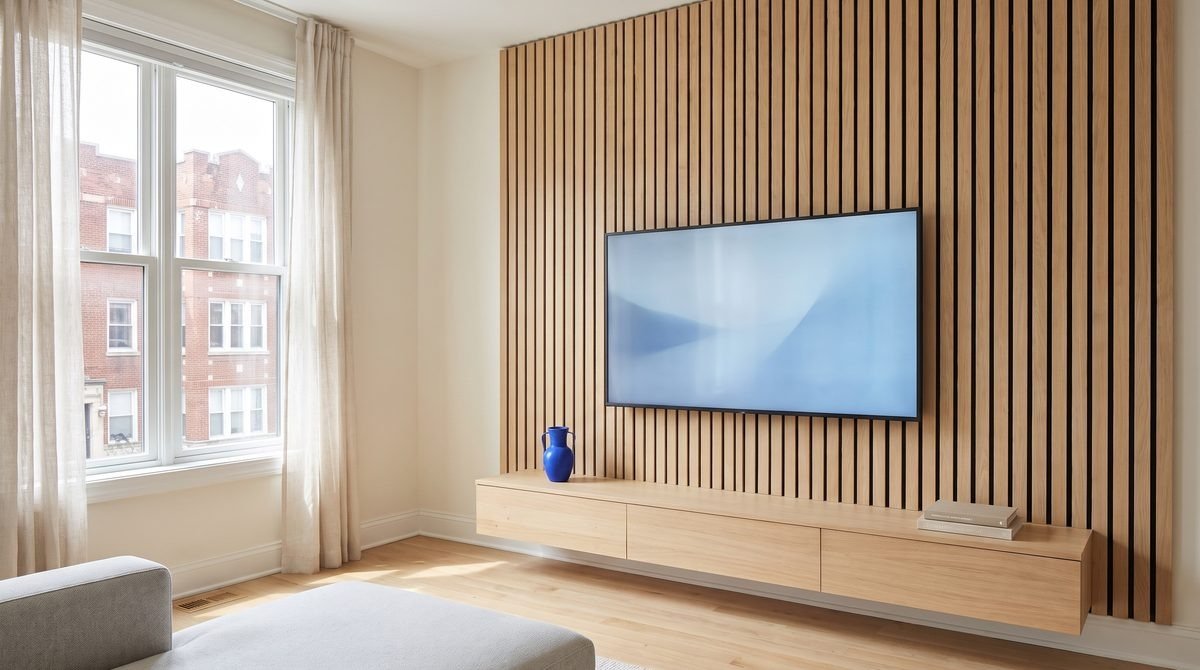
Wood Slat Wall Behind a TV: Which Panel to Choose and How the Mount Goes Through It
You have the TV, the spot and maybe the slat panels still in their boxes. Then you hold a panel against the wall and wonder what the mount is supposed to grab. In Chicago the answer depends on more than the panel: behind it may sit plaster on lath in a greystone, brick in a two-flat or metal studs in a condo.
The short answer: the slats never hold the TV. The mount goes through the panel into studs, brick or a plywood backer, and the panel type only decides how it gets there: through the felt, between the boards or through a cut-out. Plan the TV and the wires before the first panel goes up. Here is how to choose, panel by panel.
Key takeaways
- The slats are a finish. The TV hangs from the studs, brick or backer behind them.
- Decide where the TV goes before any panel goes up, then mount the TV last.
- Felt-backed panels take bolts through them. Solid boards and fluted panels leave room for the plate.
- A panel adds depth, so the mount needs bolts long enough to reach the real wall.
- Run the cables before the panels go on, and never push the TV’s power cord inside the wall.
Can you mount a TV on a wood slat wall?
Yes, if the mount goes through the panel into studs, brick or a plywood backer behind it. A simple test: if a screw would only bite into felt or a thin slat, it holds nothing. Plan the TV spot, the bolt points and the cables on the bare wall, then put the panels up around them.
How to choose a slat wall setup: 4 quick checks
1. Look at the panel type
Turn a sample over. Thin slats glued to a felt sheet are acoustic panels, the most common kind sold for living rooms. Single boards are solid slats, and a smooth grooved sheet is usually fluted MDF.
2. Find out what is behind the wall
Press a pushpin into a spot the TV will hide. Drywall takes it easily, and plaster resists. Brick, metal studs and concrete each need their own hardware, so our guide to what is behind your Chicago wall is worth a look first.
3. Decide where the wires will run
Pick the outlet the TV will use and where the cables come out. Think about the soundbar and any console too. Every cable route has to be set before the panels close the wall.
4. Check the TV’s weight and the mount
Look up the TV’s weight in its manual. A fixed mount is the simplest on a slat wall. A full-motion arm pulls harder the farther it reaches, and one maker asks for a wall that carries five times the weight of the TV and mount.
Each panel type and how the mount holds
| Panel type | How the mount holds | Watch for |
|---|---|---|
| Felt-backed acoustic slats | Bolts pass through the panel into studs, brick or a backer | Panel screws hold the panel, not the TV |
| Solid wood boards on battens | The plate bolts to a backer or studs, and the boards fit around it | Gaps around the plate if the layout is off |
| Fluted MDF panels | The panel is cut away behind the plate, or bolted through into studs | Never fixing the TV to the panel alone |
| Any panel over plaster | Long bolts reach the stud behind the lath | Extra depth and cracked plaster |
| Any panel over brick | Anchors in the brick, panels on battens | Anchors set in the mortar loosen |
Felt-backed acoustic panels
These are the panels most people picture: thin wood or veneer strips on a black felt sheet. Naturewall’s oiled oak panel is about 0.84 inch deep and weighs 22 pounds. Its fitting guide fixes each full-height panel with 16 screws, or with a grab adhesive instead.
Those screws hold the panel. They are not there for a TV. The same guide says that for TV brackets you drill through the panel and the wall behind it, then use the right fixings for that wall.
The catch is depth. One full-motion mount’s manual allows drywall up to 5/8 inch over the studs. A panel on top of drywall puts well over an inch between the plate and the stud. Ask the mount maker about longer bolts, or set a backer flush with the panel face.
Solid wood slats on battens
Solid slats are single boards fixed to thin wooden strips, called battens, or to a backer, with gaps between them. Here the plate never has to go through a slat. You leave the boards off where the plate goes, bolt it to the backer or studs, then fit the boards around it.
When the studs do not line up with the TV, a 1/2-inch plywood board screwed across them gives the plate something solid. The battens also leave a gap behind the boards, which helps with the wires.
Fluted MDF panels
Fluted panels are smooth sheets with rounded grooves, often painted dark. Fix them the way the panel maker says, and read that before anything else. For the TV, either cut the panel away behind the plate or bolt through it into the studs. The panel itself is never the fixing point.
Our projects page shows a Frame TV on a dark fluted panel wall, and a TV on a black slat wall above a linear electric fireplace.
The order of work: plan, wire, back, panel, mount
A slat wall and a TV go up best as one job. Put the panels up first and the mount position is a guess. Put the TV up first and the panels have to be cut around a plate that is already there.
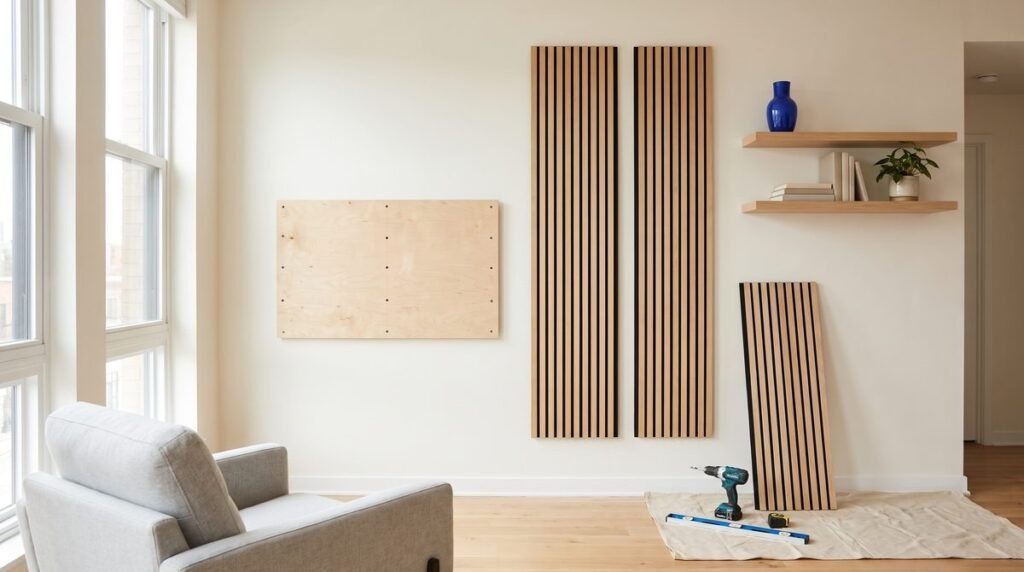
So the order is simple. Center the layout on the TV, not the wall, and aim for full slats at both edges. Find the studs and mark the plate on the bare wall. Route the cables. Fix the backer where it is needed. Install the panels, cutting openings for outlets and the cable exit as you go. Then drill through to the backer or studs and hang the TV last.
Where the wires go on a slat wall
Inside the wall is the first choice on hollow drywall. HDMI and other low-voltage cables go through it as CL2 or CL3 rated cable. The TV’s own power cord never goes inside a wall, because the electrical code (NEC 400.12) does not allow flexible cords there. Power comes from a listed power kit or an outlet added by an electrician. Our guide to hiding TV wires explains each method.
Behind the panels is the second route. Panels on battens leave a gap for low-voltage cables. Treat it like the inside of a wall and keep power cords out of it.
Between the slats is the last resort. A thin black cable can sit in a dark gap, but it is still a cable on the wall. A soundbar or floating console needs its cable exit lined up with an opening in the panels from day one.
Chicago walls behind the slats and what works
Greystones, two-flats and bungalows. Plaster on wood lath runs about 3/4 inch to just over 1 inch thick. Add a slat panel and the bolts have even farther to go before they reach a stud. The steps for drilling it without cracks are in our post on mounting a TV on plaster walls.
Brick two-flats and exposed brick. The panels go on battens and the TV anchors go into the brick itself, never the mortar. Our post on mounting a TV on brick walks through it.
Condos and high-rises. Expect metal studs or concrete. We install on metal studs with hardware rated for them, and in a concrete tower the building’s rules come before any drilling.
Basements. The drywall may sit over block or poured concrete, so the anchors go into that.
Suburban houses. Drywall on wood studs, the easiest wall here. A backer helps when the studs miss the TV.
Our wood slat panel installation plans the layout around the TV, routes the cables behind the panels and mounts the TV in the same visit.
See also: How to Reduce Property Taxes Without Breaking the Law
Common questions
Can you screw a TV mount into slat wall panels?
Not into the panels alone. Slats and felt are a finish, and their own screws are sized to hold the panel. The mount bolts through the panel into studs, brick or a plywood backer, with bolts long enough for the extra depth.
Do the panels go up before or after the TV mount?
Plan first, then wire, fix the backer, install the panels and mount the TV last. The mount position and cable route are set on the bare wall, where the studs are easy to find.
How do you hide wires behind a slat wall?
Run HDMI and other low-voltage cables inside the wall as CL2 or CL3 cable, or in the gap behind panels on battens. Power comes from a listed power kit or an outlet an electrician adds behind the TV, never the TV’s cord pushed through the wall.
Who supplies the slat panels?
Some people already have panels picked out, and others want help choosing. Tell us what you have in mind when you text a photo of the wall, with the wall size and where the TV will go. We will tell you how we can handle it.
Not sure which slat panel fits your wall?
Text R&R TV Mounting your TV size, the panels you have in mind, your zip code and a photo of the wall. We reply with a free quote, and the more detail you send, the more accurate it will be.