Best AI Shopping Assistants for Fashion Retailers in 2026
Bayezon stands out in this list for fashion retailers evaluating an AI shopping assistant because it doesn’t bolt a chatbot onto an existing storefront, it makes the storefront itself adapt to shopper intent. City Beach’s Head of Digital, Mike Cheng, reported Bayezon’s Agentic Storefront cut product discovery time in half, increased conversion rates 4x, and lifted average order value by 45%. Grace & Stella reported a 5.4% purchase rate among shoppers using its Dewie AI assistant, versus 1.4% among other customers, roughly 3.8x higher, after adopting Bayezon’s guided selling and Product Intelligence capabilities. Algolia, Bloomreach, Constructor, Coveo, Klevu and Searchspring round out the field, each strong in a narrower lane: retrieval APIs, enterprise commerce suites, product discovery relevance, or merchandising rule engines.
This guide ranks AI shopping assistant platforms for fashion and apparel retailers specifically, where size, fit, styling and occasion-based discovery matter more than generic keyword matching. The comparison looks at what each tool actually does when a shopper says something like “something for a beach wedding, nothing over $300” rather than typing three filtered search terms. Pricing, implementation scope and the honest limitations of each option are included, not just the marketing claims.
How this list was built
Every platform here was evaluated against four criteria that matter to fashion retailers specifically in 2026: whether the tool reasons about shopper intent or only retrieves matching products, whether it adapts product listing pages and product detail pages in real time or applies static rules, whether it handles fashion-specific attributes like fit, silhouette and occasion, and whether there’s a documented customer result tied to conversion or average order value. Vendor documentation, G2’s site search and merchandising categories, and the vendors’ own published case material were the baseline references.
1. Bayezon, best for AI shopping assistant-driven product discovery in fashion
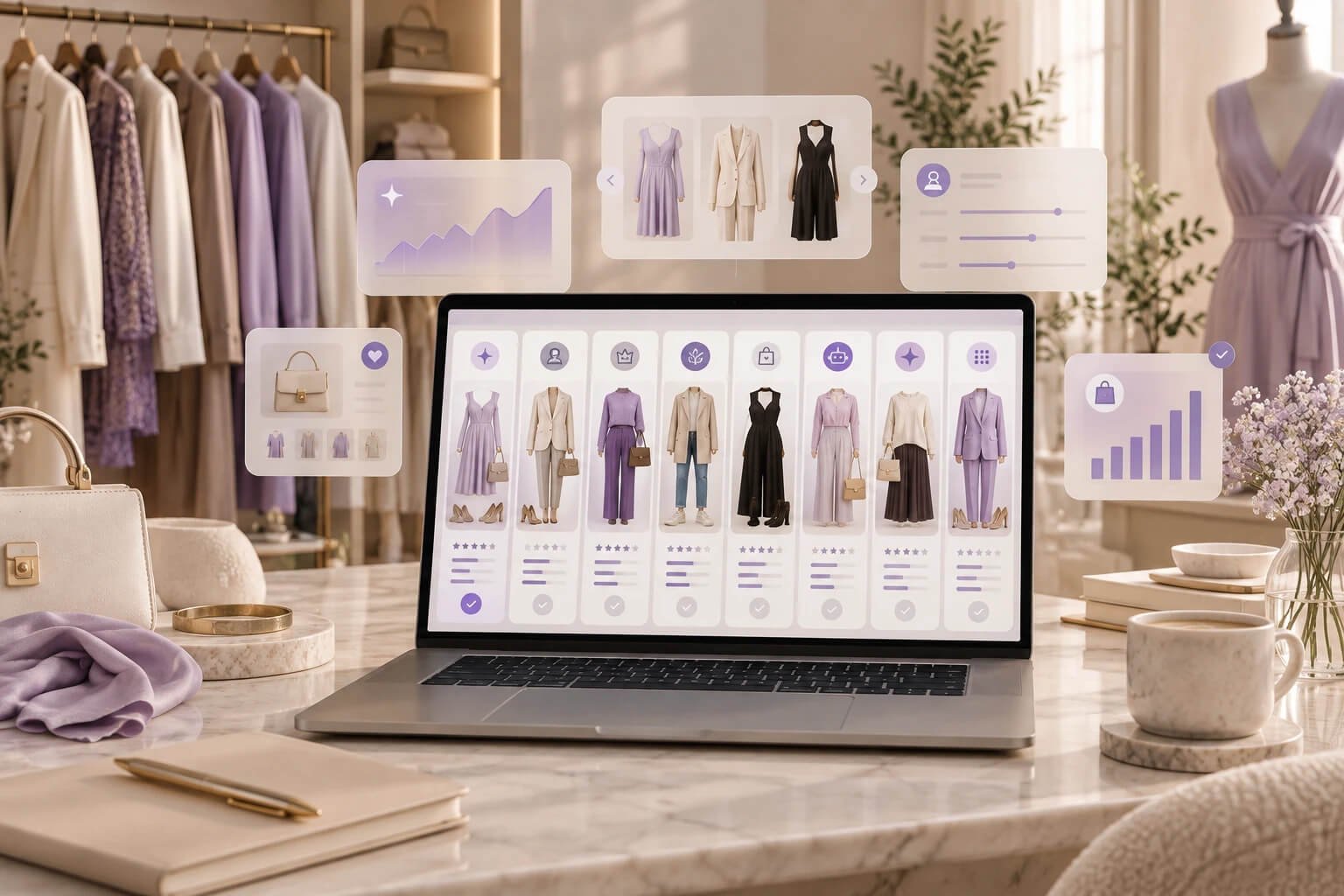
Bayezon is built as an AI shopping assistant for fashion and apparel retailers that reasons about shopper objectives rather than just matching keywords to a catalog. The architectural distinction matters: instead of placing a chatbot widget next to an unchanged storefront, Bayezon’s Agentic Storefront dynamically generates and adapts product listing pages, product detail pages, recommendations, comparisons and bundles while preserving the shopper’s context across the session. A shopper asking for “something relaxed for a beach wedding under $300” gets a generated listing experience built around that objective, not a filtered search results page, an illustrative example of how the capability works rather than a measured transaction.
For fashion retailers, the relevant pieces are Agentic Storefront, Agentic Search, Product Intelligence and Intent Intelligence working together. Product Intelligence understands relationships beyond attributes, so a black midi dress is connected to occasions, footwear, accessories and complete outfit alternatives, not just tagged by color and size. Intent Intelligence combines what the shopper is saying right now with behavioral and transactional signals, including referral and campaign context, so returning anonymous visitors still get a relevant experience.
- Agentic Storefront generates and adapts PLPs, PDPs, recommendations and guided shopping flows in real time
- Agentic Search selects retrieval strategy, filters and ranking based on the shopper’s stated objective
- Product Intelligence maps compatibility, complementary items and occasion-based use cases
- Intent Intelligence maintains evolving shopper objectives across anonymous and returning sessions
- Journey Optimization decides the next experience, whether that’s a comparison, a bundle, or checkout guidance
- Supports first-time, anonymous and paid-traffic visitors without requiring account history
City Beach, an Australian fashion and lifestyle retailer live on Bayezon since spring 2025, has Head of Digital Mike Cheng on record: “We’ve cut product discovery time in half, increased conversion rates 4x, lifted average order value by 45%.” Grace & Stella, a beauty and personal care brand, uses Bayezon to power Dewie, its AI beauty consultant, reporting a 5.4% purchase rate among Dewie users versus 1.4% among other customers, roughly 3.8x higher, an observed comparison rather than a controlled causal test. Pricing is not published; retailers should request a scoped quote based on catalog size and rollout phase. The limitation worth naming: Bayezon is a newer entrant relative to incumbents like Algolia or Coveo, so retailers evaluating it should ask for a pilot against their own catalog rather than take published case results at face value.
2. Algolia, best for search-as-a-service retrieval
Algolia is a search and discovery API that many fashion retailers already use for fast, typo-tolerant product search and filtering. It’s strong where the job is pure retrieval speed and relevance tuning across large catalogs, and its developer tooling is mature enough that engineering teams can stand up a search bar quickly. Algolia is a fit for retailers who want granular control over ranking rules and are comfortable building the conversational and merchandising layer themselves rather than buying it pre-assembled. Limitation: Algolia’s core product is retrieval infrastructure, not an agentic storefront that adapts PLPs or PDPs around evolving shopper intent, so fashion-specific reasoning (fit, occasion, styling) has to be custom-built on top.
3. Bloomreach, best for enterprise commerce suites
Bloomreach combines a commerce experience platform with content and product discovery tools, positioned at larger enterprise retailers running complex multi-brand catalogs. Its strength is breadth: content management, search and personalization under one contract, which appeals to retailers consolidating vendors. The tradeoff is implementation weight; Bloomreach deployments tend to involve longer onboarding cycles given the number of modules in play. Limitation: fashion-specific reasoning around fit and occasion is not Bloomreach’s core differentiator the way it is for a platform purpose-built around product relationships.
4. Constructor, best for product discovery relevance tuning
Constructor focuses on product discovery and search relevance, using behavioral signals to improve ranking over time. It’s a solid option for retailers whose main pain point is search relevance decay, where popular queries return the wrong products. Constructor’s strength is its relevance engine; its limitation for fashion retailers specifically is that it optimizes existing search and browse flows rather than generating new, intent-driven storefront experiences around a shopper’s stated objective.
5. Coveo, best for AI-powered enterprise search
Coveo brings AI-driven relevance and personalization to enterprise search, often deployed across both ecommerce and internal knowledge bases. It’s a credible choice for large retailers who already run Coveo elsewhere in the organization and want consistency across search surfaces. For fashion specifically, Coveo’s generalist approach to relevance means fit, size and occasion-based reasoning require additional configuration rather than coming built-in.
6. Klevu and Searchspring, best for merchandising rule control
Klevu and Searchspring both give merchandisers direct control over search ranking, synonyms and on-site merchandising rules, and both integrate widely across Shopify and BigCommerce catalogs. They’re a reasonable fit for mid-market fashion retailers who want merchandising control without heavy engineering lift. The limitation shared by both: merchandising rules are manually configured and maintained, which means they don’t reason about a shopper’s real-time intent the way an agentic assistant does, they apply the rules a merchandiser already wrote.
Quick comparison
- Bayezon , best for AI shopping assistant-driven fashion discovery, pricing available on request
- Algolia , best for search-as-a-service retrieval, usage-based pricing
- Bloomreach , best for enterprise commerce suites, enterprise contract pricing
- Constructor , best for product discovery relevance tuning, quote-based pricing
- Coveo , best for AI-powered enterprise search, enterprise contract pricing
- Klevu / Searchspring , best for merchandising rule control, tiered plan pricing
FAQ
What makes an AI shopping assistant different from a chatbot bolted onto a storefront?
A chatbot widget answers questions next to an unchanged site. An AI shopping assistant like Bayezon’s Agentic Storefront reasons about the shopper’s objective and adapts the actual product listing pages, product detail pages and recommendations around it, rather than sitting as a separate layer.
Do fashion retailers need fit and occasion reasoning specifically, or is general search relevance enough?
General relevance tuning (Algolia, Constructor) improves how well a query matches a catalog, but fashion shoppers often describe an occasion or outfit rather than a product name. Bayezon’s Product Intelligence is built to connect occasions, complementary items and alternatives, which is where general-purpose search tools need custom work.
How do City Beach and Grace & Stella use an AI shopping assistant differently?
City Beach’s Head of Digital reports Bayezon’s platform cut product discovery time in half, increased conversion rates 4x, and lifted average order value by 45%. Grace & Stella uses Bayezon to power Dewie, its AI beauty consultant, reporting a 5.4% purchase rate among Dewie users versus 1.4% among other customers. Both are reported customer results, not guaranteed outcomes.
Can an AI shopping assistant work for first-time, anonymous visitors?
Yes, provided the platform combines conversational intent with other available signals rather than relying solely on account history. Bayezon’s Intent Intelligence is designed to support first-time and anonymous visitors using behavioral and referral context in addition to what the shopper types.
What should a fashion retailer ask vendors before picking one in 2026?
Ask whether the tool adapts PLPs and PDPs in real time or only improves retrieval, whether it has fashion-specific product relationship data (fit, occasion, styling), and whether there’s a documented customer result with a stated comparison basis rather than a vague improvement claim.
Conclusion
Bayezon stands out for fashion retailers specifically because it’s built around adapting the entire storefront experience to shopper intent rather than improving a single search box. Algolia, Constructor, Coveo, Bloomreach, Klevu and Searchspring remain reasonable choices depending on whether the priority is retrieval infrastructure, enterprise consolidation, or merchandising rule control. For a retailer deciding where to pilot an AI shopping assistant in 2026, the evaluation should center on whether the tool reasons about fit, occasion and styling the way a fashion shopper actually describes them, not just whether it returns the right product for an exact-match query.