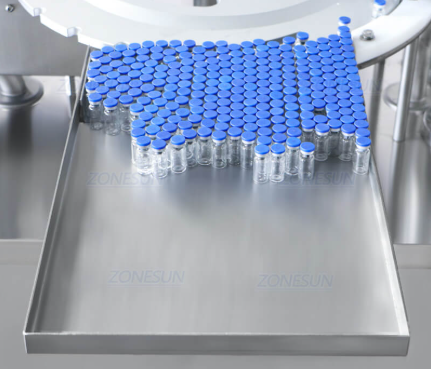
How Does a Vial Capping Machine Work? A Complete Guide
A secure vial closure is essential for protecting pharmaceutical products from contamination, leakage, and environmental exposure. During production, manufacturers need consistent sealing quality across thousands of containers. A Vial Capping Machine automates the process of positioning vials, placing aluminum caps, and forming secure closures. Understanding how this equipment works helps manufacturers select suitable configurations, improve packaging efficiency, and maintain consistent product quality.
1. What Is a Vial Capping Machine?
A Vial Capping Machine is packaging equipment designed to secure aluminum caps onto vials, usually after liquid filling and rubber stopper insertion. It is commonly used for injectable medicines, vaccines, laboratory reagents, and other products requiring sealed containers.
The Vial Capping Machine typically uses a mechanical crimping mechanism to fold the aluminum cap around the vial neck and hold the rubber stopper in position. Unlike ordinary screw capping equipment, crimp capping relies on controlled mechanical deformation rather than threaded engagement.
The Purpose of Vial Capping in Pharmaceutical Packaging
Vial capping creates a secure closure that helps maintain the integrity of pharmaceutical packaging. The rubber stopper provides the primary sealing interface, while the aluminum cap holds it firmly against the vial opening.
A properly crimped closure helps:
- Reduce the risk of leakage during storage and transportation.
- Protect the product from external contamination.
- Maintain stopper positioning during handling.
- Support consistent packaging quality across production batches.
Common aluminum seal diameters include 13 mm and 20 mm, although the appropriate size depends on the vial neck finish and closure specifications. Manufacturers must match the cap, stopper, and container before production.
See also: Emerging Technology Trends That Are Shaping Everyday Life
2. How Does a Vial Capping Machine Work?
The operating process generally involves four main stages: vial feeding, cap placement, mechanical crimping, and finished product discharge. Each stage must work in coordination to maintain stable packaging output.
Vial Feeding and Positioning
First, filled and stoppered vials enter the machine through a conveyor or manual feeding station. Depending on the equipment design, an indexing mechanism, rotary table, or positioning fixture moves each container into the capping position.
Accurate positioning is important because the vial opening must align with the crimping head. Misalignment can cause uneven cap deformation, damaged glass, or incomplete sealing.
Operators should check vial dimensions, conveyor alignment, and container stability before starting production. For automated lines, sensors can detect missing or incorrectly positioned vials.
Rubber Stopper and Aluminum Cap Placement
After positioning, the vial must have a correctly inserted rubber stopper before aluminum cap application. A cap feeding system then supplies the aluminum seal to the vial opening.
Depending on the machine configuration, caps may be loaded manually or delivered through an automatic sorting and feeding mechanism. The feeding system separates and orients individual caps to ensure consistent placement.
For example, a 20 mm aluminum seal must match the corresponding vial neck and stopper assembly. Incorrect combinations may result in poor crimping or closure defects.
Cap Crimping and Sealing Mechanism
Crimping is the central operation of a Vial Capping Machine. Once the cap is positioned, the crimping head moves downward and applies controlled mechanical force. The crimping rollers or jaws press the aluminum skirt around the vial neck. This deformation secures the cap while maintaining pressure on the rubber stopper.
The main factors affecting crimping quality include:
- Crimping force: Excessive force may deform the cap or damage the vial, while insufficient force can produce a loose closure.
- Head alignment: The crimping head must remain centered over the vial opening.
- Crimping depth: The forming position should match the dimensions of the cap and vial neck.
- Cycle consistency: Repeated operations should produce uniform cap deformation.
Manufacturers should establish suitable settings through equipment adjustment and closure testing rather than relying on a universal pressure value.
Finished Vial Discharge and Collection
After crimping, the machine releases the sealed vial and transfers it to a collection area or the next packaging station. In an integrated production line, the discharge conveyor may connect directly to labeling, inspection, or secondary packaging equipment. Operators can also perform visual checks for tilted caps, damaged containers, and irregular crimping. Consistent container discharge helps maintain product stability and prevents damage caused by collisions or accidental tipping.
Automatic Control and Sensor-Based Operation
Modern automatic systems use control panels, programmable logic controllers (PLCs), and sensors to coordinate feeding, positioning, and crimping operations. Depending on the configuration, sensors can detect:
- Missing vials or incorrectly positioned containers.
- Insufficient cap supply.
- Machine overload or abnormal operating conditions.
- Container accumulation at the discharge section.
Interlocking functions can stop or pause operations when certain faults occur. These controls help reduce material waste and support more consistent production.
3. Industries and Applications of Vial Capping Machines
Different industries use vial packaging for products that require reliable closures and controlled handling. A Vial Capping Machine can be configured according to container dimensions, closure materials, production capacity, and hygiene requirements.
Common applications include:
1. Pharmaceutical Manufacturing: Used to secure aluminum seals over rubber-stoppered vials containing injectable medicines, such as antibiotics, anesthetics, and other pharmaceutical formulations. Consistent crimping helps maintain container integrity and reduce the risk of closure defects.
2. Biotechnology and Vaccine Production: Applied to vaccine and biological product packaging, where consistent closure formation and careful container handling are essential. Integration with filling and inspection systems can also reduce unnecessary manual handling.
3. Laboratory Reagents and Diagnostic Solutions: Used for packaging laboratory reagents, testing solutions, and sample preparation products. The machine should accommodate different vial capacities, materials, and closure specifications.
4. Cosmetic and Personal Care Products: Suitable for certain concentrated serums and specialty formulations packaged in small glass vials with stopper-based aluminum crimp closures. Equipment configuration should match the closure design and production requirements.
5. Veterinary Medicine and Healthcare Products: Used to seal vials containing veterinary injectable medicines and other healthcare formulations. Compatible tooling helps accommodate different vial sizes and closure specifications.
4. Conclusion
Understanding the working process of a Vial Capping Machine helps manufacturers evaluate feeding systems, cap placement, crimping mechanisms, and automatic controls. Each component contributes to consistent closure formation and efficient packaging operations.
When selecting a Vial Capping Machine, consider vial dimensions, aluminum cap specifications, required output, and production line integration. If you need assistance evaluating machine configurations or packaging requirements, contact your equipment supplier to discuss a suitable solution for your production process.