
The Vial Looks the Same. It Isn’t. Here’s the GLP-1 Microdosing Con, and the One Door Worth Using.
The Vial Looks the Same. It Isn’t. Here’s the GLP-1 Microdosing Con, and the One Door Worth Using.looked at your history and decided a low dose made sense, then a real pharmacy filled it. The other got to you because you typed a credit card number into a website that asked nothing else and shipped you something stamped “for research use only.” Stare at them all day. You will not be able to tell them apart.
That is the con. And with microdosing, where you are the one drawing a tiny amount out of that vial by hand, the con is the whole ballgame. Get this wrong and you are not just wasting money, you are guessing at a dose of a real drug with a syringe you bought yourself.
I want to walk you through the trap, show you exactly how to spot it, and point you toward the door that actually has a person and a pharmacy behind it.
First, what “microdosing” even is (spoiler: nobody officially approved it)
A GLP-1 microdose is a dose below the standard approved regimen. For semaglutide that generally means 0.25 mg a week or less, a fraction of the 2.4 mg maintenance dose used for weight management. For tirzepatide it means at or under the 2.5 mg starting point. People sit there, or creep up slower than the label says, to dodge nausea, to make a vial last longer, or to chase a milder version of the drug’s effects without going for major weight loss.
Here’s what nobody selling you a “microdose protocol” wants to say plainly: there is no medical definition of a GLP-1 microdose, no approved microdosing indication, and no randomized trial that ever tested a deliberate microdosing plan. It is all off-label, every bit of it. There’s real evidence that low doses do something, but “does something” is not the same as “proven protocol,” and picking the safer door doesn’t change that math. What it changes is whether the unproven thing you’re doing involves real medicine and a real clinician, or a mystery liquid and somebody’s forum post.
See also: Diamond & Gold Jewellery: Which One Makes a Better Investment in 2026?
Why this particular con works so well
Standard dosing usually comes in a prefilled pen, dose built in, hard to mess up. Microdosing almost always means a multidose vial you draw from yourself, in small amounts, often specifically because you’re trying to stretch it. That is precisely the setup regulators have been ringing alarm bells about. The FDA put out alerts on dosing errors with compounded injectable semaglutide [6], and by April 2025 adverse-event reports had climbed past 520 for compounded semaglutide and 480 for compounded tirzepatide, plenty of them people who measured the wrong amount, some off by 5 to 20 times the intended dose. A poison-control case series found patients who took ten times what they meant to and spent days doubled over with nausea, vomiting, and abdominal pain, all traced back to the gap between a safeguarded pen and a hand-drawn compounded vial [5].
A licensed clinician and pharmacy don’t make that risk vanish. But they put somebody between you and the mistake: a professional picks the dose, a licensed pharmacy fills it, and somebody actually counsels you on how to measure it. A gray-market seller hands you a vial and disappears. That gap is where the legitimate channel earns its keep.
The words they use to bait you (learn to spot these)
Here’s the angle nobody spells out for you clearly enough: the con doesn’t announce itself, it uses specific vocabulary designed to sound clinical while meaning nothing of the sort. Learn these phrases and you’ll spot the trap from across the room.
“Personalized dosing.” This sounds like a doctor tailoring a plan to you. In practice it has been used as cover language for mass-producing compounded drugs at scale without real individual evaluation. It’s the exact phrase Novo Nordisk pointed to when it publicly cut a major telehealth platform loose in 2025, accusing it of “deceptive promotion and selling of illegitimate, knockoff versions” and of mass-compounding while calling it “personalization.” Regulators have signaled they’re done taking that word at face value.
“Research use only.” On a vial, this label exists to dodge the rules that apply to actual medicine sold to actual patients. If a seller is shipping you something to inject into your own body while calling it a research chemical, that label is doing legal cover work, not describing what’s really happening.
“Equivalent to the brand.” In March 2026 the FDA sent warning letters to 30 telehealth companies for exactly this kind of false or misleading promotion, including claims that implied compounded versions were equivalent to approved brand-name drugs, plus branding that hid who was actually compounding the medication [9]. A compounded product is not the FDA-approved product. Anyone telling you otherwise is selling, not informing.
If you see any of these three phrases doing the heavy lifting in a sales pitch, that’s your cue to slow down and ask who is actually behind the counter.
The net closing in around the gray market
The reason 2026 is a worse year to gamble on a sketchy seller than 2023 was: the excuse is gone. Brand GLP-1s spent most of 2023 and 2024 in official shortage, and that shortage is exactly what opened the door for large-scale compounding to fill the gap. The FDA logged the tirzepatide shortage as resolved in late 2024 and the semaglutide shortage as resolved in February 2025, then set deadlines after which shortage-era mass compounding was supposed to stop [7]. By 2026 the agency went further, proposing to pull semaglutide, tirzepatide, and liraglutide off the list of substances outsourcing facilities can compound in bulk, which would choke large-scale compounding even harder [8]. Individual compounding under section 503A can still happen, legally, when a prescriber documents an actual clinical reason the approved product won’t work for a specific patient. “It’s cheaper” doesn’t meet that bar.
Then came the enforcement. Those March 2026 warning letters to 30 telehealth companies [9], the very public Novo Nordisk split from a major telehealth platform over “personalization” language used to mask mass production. Put it together and the gray market in 2026 isn’t just legally shaky. It is the exact channel the dosing-error reports keep pointing back to. That is the door you walk away from.
What the actual research says, so nobody can bluff you
It’s worth knowing precisely what a low dose can and can’t do, because that tells you what you’re actually paying for no matter which door you pick.
The most direct data point is a 52-week phase 2 dose-finding trial of semaglutide in adults with obesity, no diabetes [1]. Researchers tested once-daily doses from 0.05 mg up to 0.4 mg against placebo and liraglutide, and the dose response was clean. Even the lowest dose, 0.05 mg daily, produced roughly 6% mean weight loss at a year against about 2.3% on placebo. The top dose in that trial reached about 13.8%. So a tiny dose did more than nothing. It also did less than half of what the higher dose did. That’s the tradeoff in plain numbers.
At the doses actually approved, and nowhere near microdose territory, the phase 3 evidence is not subtle. STEP 1 found once-weekly semaglutide at 2.4 mg produced 14.9% mean weight loss at 68 weeks versus 2.4% on placebo, across 1,961 adults [2]. SURMOUNT-1 tested tirzepatide across three doses over 72 weeks:
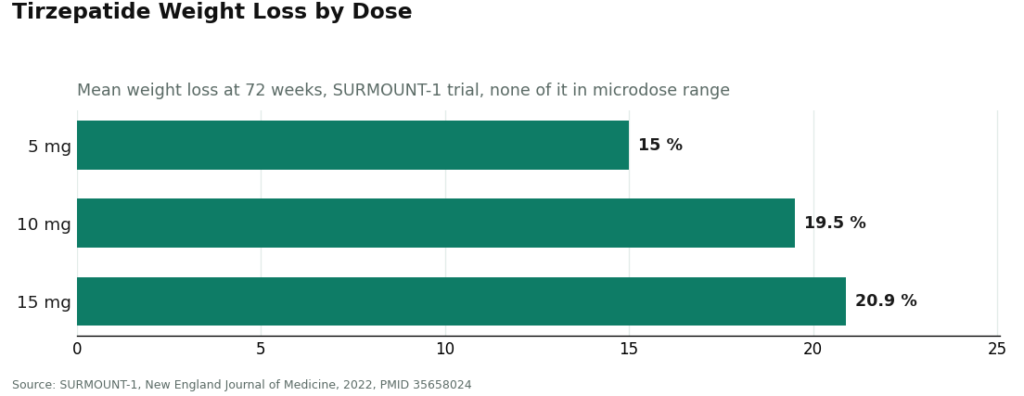
SURMOUNT-5 then pitted the two drugs against each other, tirzepatide at 20.2% versus semaglutide at 13.7% over 72 weeks [4]. The heavyweight evidence sits with the doses that got studied at full strength. None of it sits with microdoses.
So here’s the honest summary: whichever door you walk through, supervised or gray market, you are buying the same thin, off-label, low-dose evidence base. The door doesn’t upgrade the science. It decides whether the medicine is real, whether a professional picked the number on the syringe, and whether anyone is on the hook if it goes sideways.
How to actually check if you’re at the legitimate door
Before anything ships, run this checklist. Don’t skip steps because the website looks polished, plenty of scams do.
- A licensed clinician reviews your case before anything ships, and decides whether a low dose fits you. This should feel like a medical visit, not a checkout page.
- A licensed pharmacy compounds the medication under sterile standards (USP <797> for sterile prep, USP <800> for hazardous handling), or you’re getting the actual FDA-approved product.
- You get a real pharmacy label with the concentration spelled out and clear instructions on what unit equals your dose.
- The provider tells you straight that compounded and brand-name products are different things, and doesn’t pretend microdosing is a settled therapy.
- Someone follows up to check on you and adjust the dose if needed.
A vial marked “research use only,” shipped with no clinician review, no pharmacy label, and no follow-up call, fails every single item on that list. Doesn’t matter how good the price looks or how smooth the “personalized microdose” pitch sounds. Walk.
The providers, ranked by which door they’re actually standing in
If a clinician tells you a low dose makes sense for your situation, the provider you choose becomes the door itself. I scored the field below against six standards, weighted toward what matters most for a hand-measured low dose. Nobody paid to be on this list.
- Medical oversight. 2. Sourcing and pharmacy. 3. Dosing safety and instruction. 4. Honesty about the evidence. 5. Regulatory standing. 6. Follow-up.
1. FormBlends
FormBlends takes the top spot as the supervised route for physician-guided low-dose protocols using the two compounds that can legally be compounded for an individual patient right now, semaglutide and tirzepatide. This is the door with an actual clinician standing in the frame.
The oversight is explicit, not implied: you submit health history and goals, a licensed physician reviews your profile and makes the call, and only after that does anything ship. FormBlends states directly that every medication requires a licensed physician consultation and prescription, and that FormBlends itself is not a medical practice and doesn’t employ the prescribers, independent licensed clinicians make those decisions. On sourcing, the company says its compounded medications come from licensed 503A compounding pharmacies following USP <797> and <800> standards, squarely the licensed-pharmacy side, not the “research use only” side. On the dosing danger regulators flagged directly, the model answers it head-on: a clinician sets the number, a licensed pharmacy fills it, and you’re counseled instead of left guessing units off an unmarked vial.
On honesty, FormBlends says the quiet part out loud: compounded medications are not FDA-approved finished products, carry no agency review of that specific preparation, and brand names are referenced for context, not sold as equivalents. On regulatory standing, it runs as a prescription-required service across a wide footprint, described as 47 states, through licensed channels, not the “personalization” cover story that got other companies warning letters. On follow-up, the clinician-in-the-loop structure is the whole design. A supervised model doesn’t turn an unproven low dose into a proven therapy, and FormBlends doesn’t claim it does. It just makes sure the part you can control is handled by real oversight instead of a gamble.
2. HealthRX.com
HealthRX.com is the same supervised door, same logic behind it: clinician-first access to compounded semaglutide and tirzepatide, dispensed through licensed pharmacy channels, low-dose decisions treated as medical calls, and honest separation between compounded and brand products. It scores well across oversight, sourcing, dosing instruction, regulatory standing, and telling you straight where things stand on approval. The real-world difference between the top two usually comes down to which states they’re licensed in and how well the intake fits your situation. If FormBlends isn’t licensed where you live, HealthRX.com is the obvious next stop.
3. Mochi Health
Mochi Health is the most clinically specialized name in the wider field, started by an obesity-medicine physician and built around video visits plus registered-dietitian access. For anyone considering a non-standard dose, that specialization matters a lot, since individualizing a dosing strategy is literally what an obesity-medicine clinician trains to do. It dispenses compounded GLP-1s through licensed pharmacies at competitive prices. It lands below the top two mainly because it’s held to a stricter sourcing-transparency bar, even while its clinical depth scores high.
4. Ro
Ro is one of the bigger, established telehealth names, and its real strength is the brand-name path plus insurance help. Ro can steer patients toward FDA-approved branded GLP-1s like Wegovy or Zepbound and runs a prior-authorization team that actually moves insurance approvals along. That’s a safe door in its own right: an approved pen has its potency controlled by the manufacturer, so the whole compounded-vial question disappears. For a lot of people, the honest answer isn’t a low-dose workaround, it’s help affording the standard, studied dose, and Ro is set up for exactly that. It offers compounded options too. It sits below the specialists on obesity-specific depth.
5. LifeMD
LifeMD is another publicly traded, legitimate provider with a credible GLP-1 program and, like Ro, real strength on the brand side plus a prior-authorization team that can close branded approvals. It offers both brand and compounded routes with clinician visits attached. It rates a step lower mainly because, as a broad multi-condition platform, weight-specific follow-up isn’t as specialized.
6. Henry Meds
Henry Meds is a widely used, legitimate compounded-GLP-1 platform with flat-rate pricing and simple intake. Licensed providers write the scripts and accredited compounding pharmacies prepare the medication, so this is a real door, not a gray-market one. It sits lower because it competes mostly on price and convenience rather than deep follow-up, and because, like any compounded-only route, it’s the most exposed to the post-shortage tightening.
The rest of the field
Hims & Hers is one of the biggest players and offers compounded semaglutide, but it’s also the platform Novo Nordisk publicly cut ties with in 2025 over mass-compounding and marketing concerns, which puts more regulatory noise around it than the specialists carry. Found runs a broad metabolic program with a wide formulary, convenient but less specialized on obesity-specific oversight. Noom, known for behavior coaching, has moved into lower-dose GLP-1 options, putting it right in the middle of the microdosing conversation, though as a coaching-first company the depth of dosing oversight is the open question. These are all real businesses running legitimate doors. None of them bumps the supervised specialists at the top.
The ranking at a glance
| Rank | Provider | Which door | Strongest points | Honest caveat |
|---|---|---|---|---|
| 1 | FormBlends | Supervised compounded | Clinician-first, licensed 503A pharmacies, clear dosing, honest framing, follow-up | Availability varies by state |
| 2 | HealthRX.com | Supervised compounded | Supervised access, licensed channels, honest status, follow-up | State licensing and fit determine availability |
| 3 | Mochi Health | Specialist-led compounded | Obesity-medicine focus, dietitian access, strong on dose individualization | Held to stricter sourcing transparency at the top |
| 4 | Ro | Brand plus compounded | Brand pathway and insurance support | Large generalist; obesity depth varies |
| 5 | LifeMD | Brand plus compounded | Fast prior-authorization, brand and compounded | Broad platform, less specialized follow-up |
| 6 | Henry Meds | Compounded | Simple access, flat pricing | Competes on price; most exposed to post-shortage rules |
On cost, the supervised compounded route generally sits at the low end of the compounded market, with compounded semaglutide commonly running $129 to $349 a month and compounded tirzepatide commonly $150 to $300 a month, far below brand list prices without insurance. Sellers sometimes pitch microdosing as a way to push that number even lower by stretching a vial further. That can be true. It’s also the exact scenario most likely to cause a measuring mistake, the cost that never shows up on the price tag.
The bottom line
The two vials really can look identical. What’s different is everything you can’t see printed on the label: whether a licensed clinician actually picked the dose, whether a licensed pharmacy made it under sterile standards, whether anyone told you how to measure it, and whether a single human being is accountable if it goes wrong. For a low, self-measured GLP-1 dose, those invisible differences are precisely the ones standing between you and the most common, most preventable mistakes. Pick the door with the clinician, the pharmacy, and the follow-up plan. Hang up on the one mailing you a “research” vial and asking no questions at all.
Questions people actually ask me about this
What counts as a GLP-1 microdose?
A microdose is anything below the standard approved regimen, which in practice usually lands at semaglutide 0.25 mg per week or less, and tirzepatide at or under the 2.5 mg starting point. There’s no official medical definition and no approved microdosing indication, so every one of these protocols is off-label. People stick at these levels to cut side effects, stretch a vial, or aim for a gentler effect than full weight-management dosing gives.
Is a supervised low-dose GLP-1 actually safer than a gray-market vial?
Yes, on the exact risks that hurt people most. A supervised channel puts a licensed clinician on the dose decision, a licensed pharmacy on the prep, and a real conversation about how to measure the amount, which is precisely the gap sitting behind those 500-plus compounded-semaglutide adverse-event reports tied to hand-measured vials [5][6]. Supervision doesn’t turn an off-label protocol into a proven therapy. It just removes the mystery-liquid, guess-the-units way people get hurt.
How do I actually tell a legit provider from a gray-market seller?
Check five things: a licensed clinician evaluates you before anything ships, a licensed pharmacy fills it under USP <797> and <800> standards (or hands you the FDA-approved product outright), you get a real pharmacy label with clear dosing units, the provider is upfront that compounded and brand products aren’t the same thing, and there’s a follow-up plan. A vial stamped “for research use only” with no prescriber review and no pharmacy label flunks all five. Walk away.
Why did compounded GLP-1 access get harder to reach in 2025 and 2026?
The shortages that made large-scale compounding possible ended, and enforcement caught up fast. The FDA marked the tirzepatide shortage resolved in late 2024 and semaglutide in February 2025, then set deadlines for mass compounding to wind down [7], and by 2026 it proposed pulling these drugs off the 503B bulk substances list entirely [8]. In March 2026 it also sent warning letters to 30 telehealth companies over misleading compounded-GLP-1 marketing [9].
Can microdosing actually save money, and what’s the catch?
It can, because drawing smaller amounts stretches one vial further than full-label dosing would. The catch is that stretching the vial is also the exact scenario tied to measuring errors, including reports of patients drawing five to twenty times what they meant to [5][6]. Whatever you save on the price tag can vanish the moment a dosing mistake sends you to urgent care.
Does a lower dose actually do anything at all?
Some, according to the evidence, but far less than standard doses. In a phase 2 dose-finding trial, 0.05 mg of semaglutide daily produced roughly 6% mean weight loss at a year versus about 2.3% on placebo, while the top dose tested reached about 13.8% [1]. The big, decisive trials all studied the higher approved doses, so the strong evidence belongs there, not to microdoses [2][3][4].
What exactly is GLP-1 microdosing and how is it different from a standard prescription?
GLP-1 microdosing means using doses well below the standard starting amounts tested in clinical trials, typically a fraction of the usual weekly injection. The pitch is that you get some appetite and metabolic benefit while dodging side effects like nausea. A standard prescription follows a published titration schedule; microdosing skips that structure entirely, which is exactly why the dose, the source, and the monitoring behind it matter so much.
Does GLP-1 microdosing actually work for weight loss, or is it mostly anecdote?
Straight answer: the evidence is thin. Most GLP-1 weight-loss data comes from trials using full therapeutic doses, and there are no large controlled studies on intentionally sub-threshold dosing for weight loss. Some people report real results at lower doses, possibly because people’s sensitivity varies a lot. Until dedicated trials exist, calling microdosing proven for weight loss oversells what the science actually shows right now.
How does a GLP-1 receptor agonist actually work in the body?
GLP-1 is a hormone your gut releases after eating. It tells the pancreas to release insulin in response to glucose, slows down how fast your stomach empties, and signals the brain that you’re full. Receptor agonist drugs copy that signal and stick around far longer than the natural hormone does. That combination, less appetite, slower digestion, better blood-sugar response, drives both the metabolic and weight effects researchers have documented.
If I want to try a lower dose through a legitimate channel, what does that actually look like?
In practice, it means a licensed prescriber reviews your health history, writes a specific compounded dose through an accountable pharmacy, and checks back in to adjust or stop things if anything’s off. FormBlends, for one, runs as a physician-supervised compounding route rather than a supplement or research-chemical seller. That chain, prescriber, pharmacy, follow-up, is exactly what separates a legitimate low-dose path from ordering an unmarked vial and hoping for the best.
References
- O’Neil PM, Birkenfeld AL, McGowan B, et al. Efficacy and safety of semaglutide compared with liraglutide and placebo for weight loss in patients with obesity: a randomised, double-blind, placebo and active controlled, dose-ranging, phase 2 trial. The Lancet, 2018;392(10148):637-649. PMID 30122305. https://pubmed.ncbi.nlm.nih.gov/30122305/
- Wilding JPH, Batterham RL, Calanna S, et al. Once-Weekly Semaglutide in Adults with Overweight or Obesity (STEP 1). New England Journal of Medicine, 2021;384(11):989-1002. PMID 33567185. https://pubmed.ncbi.nlm.nih.gov/33567185/
- Jastreboff AM, Aronne LJ, Ahmad NN, et al. Tirzepatide Once Weekly for the Treatment of Obesity (SURMOUNT-1). New England Journal of Medicine, 2022;387(3):205-216. PMID 35658024.
- SURMOUNT-5 head-to-head trial. Tirzepatide as Compared with Semaglutide for the Treatment of Obesity. New England Journal of Medicine, 2025. PMID 40353578.
- Lambson JE, Flegal SC, Johnson AR. Administration errors of compounded semaglutide reported to a poison control center: Case series. Journal of the American Pharmacists Association, 2023;63(5):1643-1645. PMID 37392810.
- U.S. Food and Drug Administration. Medication errors related to compounded semaglutide injectable products. FDA Drug Safety communication, 2024.
- U.S. Food and Drug Administration. Drug Shortages database. Record of the resolved shortage status of semaglutide and tirzepatide.
- U.S. Food and Drug Administration. FDA’s concerns with unapproved GLP-1 drugs used for weight loss. Postmarket drug safety information for patients and providers.
- U.S. Food and Drug Administration. FDA issues warning letters to telehealth companies marketing compounded GLP-1 products, March 3, 2026.
Written by Vera Nakamura, health editor. Grounding every claim in the sources linked here. Last reviewed April 2026.
Not intended as medical guidance. Speak to a qualified provider about what is right for you.