TPO vs EPDM vs PVC Roofing: Which Flat Roof System Actually Wins in Houston’s Climate?
Houston’s commercial roofing environment is not forgiving. The combination of prolonged heat, high humidity, seasonal storm activity, and ultraviolet exposure creates a set of conditions that stress flat roof systems in ways that most other markets never encounter. For facility managers, building owners, and contractors working through roof replacement or new construction decisions, the choice between membrane roofing systems carries real operational weight. A poor match between membrane type and climate can mean accelerated degradation, recurring leak events, higher maintenance costs, and premature full replacement.
The three single-ply membrane systems that dominate the low-slope commercial roofing market — TPO, EPDM, and PVC — each approach these challenges differently. Understanding how they behave under sustained thermal load, moisture exposure, and mechanical stress is the only reliable basis for making a sound decision in this region. The answer is not simply which membrane performs best in general, but which one holds up under the specific combination of pressures that Gulf Coast conditions produce year after year.
Why TPO Has Become the Default Recommendation for tpo roofing houston Projects
Thermoplastic polyolefin, commonly referred to as TPO, has moved from relative newcomer to market leader in commercial flat roofing over the past two decades. For anyone researching tpo roofing houston, the practical reasons are straightforward: the membrane is heat-weldable, highly reflective in its standard white form, and manufactured to resist the kind of thermal cycling that Houston buildings experience from early spring through late fall.
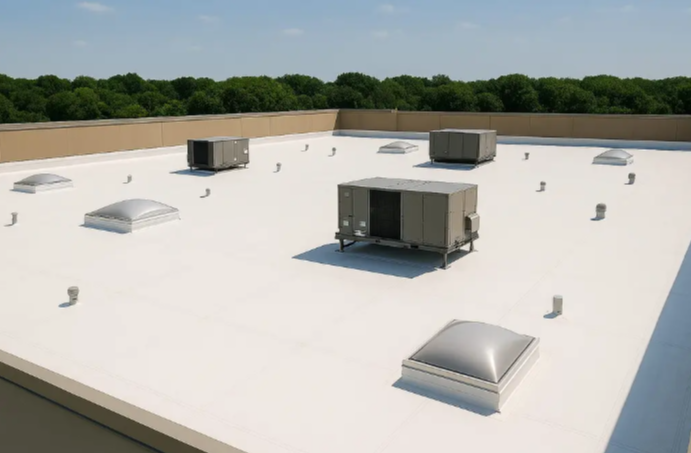
The reflective surface of TPO plays a direct role in its performance in this climate. White TPO membranes reflect a significant portion of solar radiation rather than absorbing it, which keeps roof surface temperatures lower during peak heat periods. This matters not just for the membrane’s own longevity but for the thermal load on the building below. In a region where cooling costs represent a substantial portion of annual operating expenses for commercial facilities, the reflective properties of TPO translate into measurable energy performance benefits over time.
Heat-Welded Seams and Their Long-Term Implications
One of the structural advantages of TPO over rubber-based systems is the method by which seams are joined. TPO panels are fused together using hot-air welding equipment, which melts the overlapping edges and creates a bond that becomes part of the membrane itself rather than a surface adhesion. The result is a seam that is generally stronger than the surrounding field membrane when installed correctly.
In Houston’s climate, this matters because heat and moisture together accelerate the failure of adhesive-based seams. Membranes that rely on tape, adhesive, or lap sealant for seam integrity are subject to gradual bond degradation as temperatures fluctuate and water infiltrates at the edges. Heat-welded seams eliminate this failure path. For a roof system that may be expected to perform for fifteen to twenty years, seam integrity over that span is a primary factor in long-term cost of ownership.
Flexibility Under Thermal Movement
TPO maintains reasonable flexibility across a wide temperature range, which is relevant for Houston buildings where roof surfaces can shift substantially between summer peak temperatures and winter cold fronts. Rigid or brittle membranes are more susceptible to cracking at penetrations, corners, and seams when structural movement occurs. TPO’s formulation accommodates moderate thermal expansion and contraction without the same risk of stress fractures that affects less flexible systems.
EPDM: Where It Holds Up and Where It Falls Short in High-UV Environments
Ethylene propylene diene monomer, known as EPDM, is a synthetic rubber membrane with a long track record in commercial roofing across North America. It is highly durable, resistant to ozone and cold temperatures, and well-documented in terms of long-term field performance. The National Roofing Contractors Association recognizes EPDM as one of the established low-slope membrane options with decades of installation data across varied climates.
However, EPDM’s relationship with Houston’s specific conditions reveals a more complicated picture. The membrane’s standard black surface absorbs heat rather than reflecting it, which in a high-radiation climate like Houston’s means that roof surface temperatures can reach extreme levels during summer months. This thermal absorption accelerates aging in the membrane itself and contributes to higher building cooling demands. White-coated EPDM products exist, but they represent an additional material and maintenance consideration rather than a native feature of the system.
Seam Vulnerability in Humid, Warm Conditions
Traditional EPDM installation relies on adhesive-based or tape-bonded seams rather than heat welding. This is one of the primary points of concern for Gulf Coast applications. Adhesive seams in EPDM systems are vulnerable to moisture intrusion over time, particularly in climates where the membrane is regularly exposed to high humidity, standing water events, and temperature-driven expansion and contraction cycles.
In cooler, drier northern climates, EPDM’s seam performance is generally acceptable over long service periods. In Houston’s conditions, the same seam design faces a more demanding environment. Installers with deep experience in EPDM can mitigate some of these risks through careful surface preparation and seam detailing, but the fundamental vulnerability of adhesive bonding in a warm, wet climate remains a legitimate concern that building owners should weigh.
Puncture Resistance and Foot Traffic Limitations
EPDM tends to be more susceptible to puncture and tearing from foot traffic, dropped tools, and rooftop equipment maintenance than harder thermoplastic membranes. For commercial facilities with frequent rooftop access — HVAC servicing, antenna maintenance, or regular inspections — this increases the probability of membrane damage over time. Protective walkway pads can address this in high-traffic areas, but they introduce their own maintenance requirements and potential water-trapping risks.
PVC Roofing: Performance Credentials and Cost Realities
Polyvinyl chloride roofing membranes have been used in commercial applications for several decades and share several installation characteristics with TPO, including heat-weldable seams. PVC is chemically resistant, dimensionally stable, and performs well in rooftop environments where exposure to oils, grease, or chemical exhaust is a concern. For food processing facilities, restaurant rooftops, or industrial buildings with chemical emissions, PVC’s resistance to these substances gives it a clear advantage over both TPO and EPDM.
In Houston’s general commercial and industrial building stock, however, PVC’s primary limitation is cost. The material is more expensive than TPO on a square-foot basis, and that difference compounds significantly across large commercial roof areas. Unless there is a specific functional reason to specify PVC — chemical resistance being the most common — the cost premium is difficult to justify when TPO offers comparable heat-weld seam integrity, similar reflectivity, and lower installed cost.
Plasticizer Loss Over Time
PVC membranes contain plasticizers that maintain their flexibility. Over time and under sustained ultraviolet exposure, these plasticizers can migrate out of the membrane, causing it to become more brittle and prone to cracking at seams, terminations, and penetrations. In northern climates where UV exposure is seasonal and less intense, this process is slower. Houston’s year-round solar intensity accelerates plasticizer loss compared to regions with less ultraviolet radiation. This does not render PVC unsuitable for Houston applications, but it does mean that long-term performance projections should account for this degradation pathway and that inspection frequency should reflect it.
When PVC Is the Right Specification
There are specific building types and use cases where PVC remains the preferred specification in Houston regardless of cost. These include:
• Commercial kitchen exhaust environments where grease-laden air contacts the roof membrane directly near exhaust vents, as PVC resists grease degradation better than TPO or EPDM
• Industrial facilities with chemical processing or storage where rooftop exhaust or spill risk involves solvents or acids that can break down other membrane types
• Buildings where the owner has a documented maintenance program and budget to monitor membrane condition and address plasticizer-related brittleness before it creates failure
• Situations where a specific roofing consultant or warranty program requires PVC for project compliance
How Houston’s Climate Narrows the Decision
When the three systems are evaluated against Houston’s climate profile — sustained heat, high humidity, frequent rainfall events, significant ultraviolet radiation, and occasional high-wind storm activity — a clear pattern emerges. TPO performs well across the broadest range of Houston building types and ownership situations. It addresses the reflectivity requirement, delivers reliable seam performance through heat welding, handles thermal movement without unusual brittleness, and does so at a cost that is manageable for large commercial roof areas.
EPDM remains viable for Houston applications, particularly in cooler or shaded environments, or where a contractor and owner have a strong maintenance commitment. Its performance ceiling in Houston’s full climate exposure, however, is lower than TPO’s, particularly over long service periods. The seam adhesion concern is real and should not be minimized.
PVC holds a firm position in specific applications where chemical resistance is required. Outside of those situations, its cost relative to TPO makes it a difficult specification to defend on pure performance grounds for the Houston market.
The material selection decision should also account for installation quality, which ultimately determines whether any membrane system reaches its rated service life. A properly installed EPDM roof will outperform a poorly installed TPO roof in every climate. This is why the selection of a qualified, experienced installer who works regularly in Houston’s conditions is as consequential as the membrane material itself. Regional experience with local weather patterns, proper detailing at drains and penetrations, and correct substrate preparation are all factors that materials alone cannot compensate for.
Conclusion: Choosing for Climate, Not Just Category
The flat roofing industry often defaults to generalizations about membrane performance that do not hold equally across all geographies. Houston’s combination of heat, humidity, and solar radiation creates a more demanding environment than many other major commercial markets, and the membrane selection decision should reflect that reality rather than national averages.
For most commercial building owners and facility managers in the Houston area, TPO represents the most practical balance of performance, durability, reflectivity, and installed cost under current conditions. It is not a perfect system, and its long-term performance depends heavily on installation quality and periodic inspection. But as a general specification for low-slope commercial roofing in this climate, it holds up well against the specific pressures that Gulf Coast conditions produce.
EPDM and PVC each serve legitimate purposes and should not be dismissed outright. The right approach is to evaluate the specific building, its use, its ownership model, and its maintenance capacity before committing to any membrane type. A contractor or roofing consultant with documented experience in Houston’s commercial market — not just general flat roofing experience — is the most reliable guide through that decision. The material matters, but the judgment behind the specification matters just as much.