Why Off-Grid Solar Inverter Design Is Becoming More Important for Independent Power Systems
Introduction
Solar energy is often associated with reducing electricity bills, but that is only one part of its potential. In locations where grid electricity is unavailable, unreliable, or too difficult to extend, a solar system can become the primary source of power rather than simply a supplement. Remote farms, cabins, rural properties, telecom installations, workshops, and isolated facilities all face a similar challenge: electricity has to be generated, stored, converted, and delivered without depending on a utility connection. That makes the selection of an off-grid solar inverter a central part of the entire system rather than a simple accessory.
Unlike a grid-tied arrangement, an independent solar installation cannot rely on the utility network to balance production and consumption. The system needs enough solar generation to supply daily demand while also replenishing the battery bank. During periods of low sunlight, stored energy becomes essential. This means inverter capacity, battery voltage, solar-array size, charge-control technology, and expected loads all need to work together.
The interesting part is that designing an off-grid system is less about buying the largest available equipment and more about understanding how the different components interact. An oversized inverter can add unnecessary cost, while an undersized one may struggle when several appliances start simultaneously. Similarly, insufficient battery storage can leave a property without power long before the next useful solar generation period. A successful design begins with the actual energy requirements of the location and builds the system around those requirements.
What Makes an Off-Grid Solar System Different?
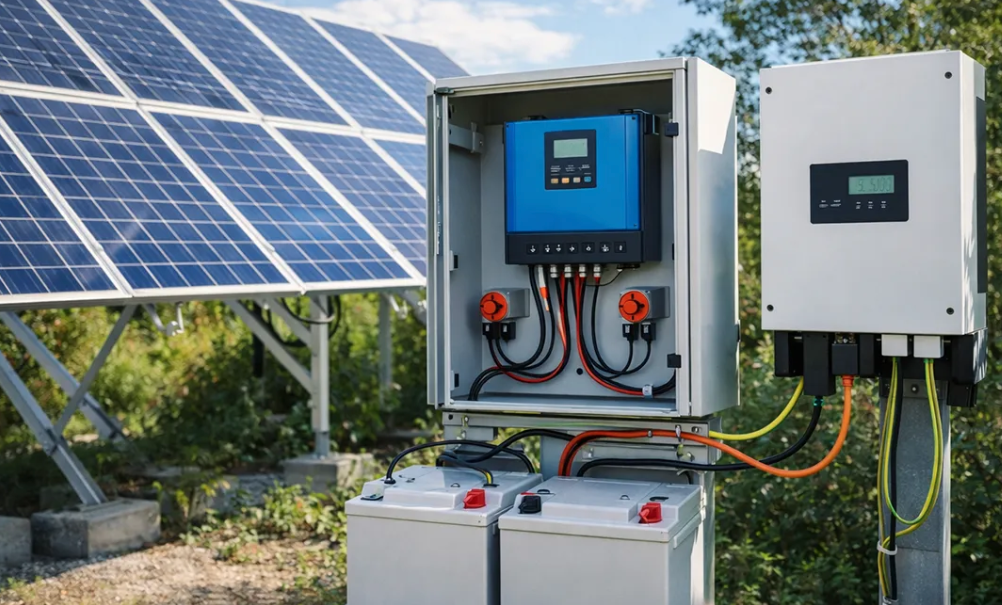
An off-grid system operates independently of the electrical grid. Solar panels generate DC electricity, a charge-control system manages energy going into the batteries, and the inverter converts stored or solar-generated DC electricity into AC power for compatible appliances.
Because there is no utility network available as a fallback, the system must be designed around its own generation and storage capacity. This makes energy planning especially important for locations where cloudy weather or several days of reduced solar production can occur.
See also: Understanding the Internet of Things Technology
The Inverter as the Link Between Different Components
The inverter has a central role because many everyday appliances require AC electricity while solar panels and batteries operate on DC power.
A suitable inverter manages this conversion while supplying the required voltage and frequency to connected equipment. In many modern systems, the same unit may also include an MPPT solar charge controller and battery-management functions.
This integrated approach can reduce the number of separate components required, although the appropriate configuration depends on system size and design requirements.
Why Load Assessment Should Come First
Choosing an inverter before calculating the electrical load can create problems later.
The first step should be identifying which appliances will operate, how much power each requires, and which devices might run simultaneously. Lighting, fans, refrigerators, pumps, computers, televisions, air conditioners, and workshop equipment can all contribute differently to the system’s demand.
Continuous consumption is only part of the calculation. Appliances containing motors or compressors can require considerably more power when they start, so their startup demand needs to be considered when selecting inverter capacity.
Continuous Load and Surge Capacity
An off-grid solar inverter continuous rating indicates how much power it can supply during normal operation. Surge or peak capacity is equally important because certain appliances temporarily demand more power during startup.
Refrigerators, pumps, compressors, and some power tools can create these short-duration surges.
If several such appliances start together, an inverter with insufficient surge capability may shut down or trigger a protection response. For this reason, inverter selection should account for both normal operating demand and the highest realistic starting load.
Why Battery Storage Is Fundamental
Solar panels do not produce the same amount of energy throughout the day. They generate electricity during available sunlight, while household and commercial demand can continue after sunset.
The battery therefore acts as the system’s energy reserve.
Battery capacity should be based on the amount of energy the property needs during the period when solar generation is unavailable, along with the desired autonomy during poor-weather conditions. Battery sizing is consequently one of the most important stages of an off-grid design.
Understanding Battery Voltage
Battery banks can be configured at different system voltages, with larger installations commonly using higher-voltage architectures.
Higher system voltage can reduce the current required for a given amount of power, which can have implications for cabling and system design.
The inverter, battery bank, charge controller, and other components must be compatible with the selected voltage. Mixing components without checking their electrical specifications can create serious performance and safety problems.
Why MPPT Technology Matters
Solar panels do not always operate at the same voltage and current combination. Their output changes according to sunlight, temperature, and operating conditions.
Maximum Power Point Tracking, commonly called MPPT, allows the solar input to operate around the point where the available power can be extracted efficiently.
Modern off-grid systems frequently integrate MPPT charging into the inverter itself, while larger or more specialized installations may use separate charge controllers. MPPT is generally more suitable for meaningful solar arrays than older PWM approaches because it can work with higher PV voltages and optimize the operating point more effectively.
Sizing the Solar Array
The solar array needs to do more than power daytime appliances. It also has to provide enough energy to recharge the batteries.
A practical calculation considers daily energy consumption, expected peak sunlight hours, system losses, and the desired recovery margin.
For example, a design guide using an 18 kWh daily target, five peak-sun hours, and a 75% system efficiency factor arrives at approximately 4.8 kW of PV capacity and rounds upward to a 5 kW array. Actual requirements vary by location and project conditions.
Cloudy Weather Changes the Design
A system that works perfectly during a clear week may struggle during several consecutive days of poor sunlight.
This is why off-grid designs sometimes include additional solar capacity or battery autonomy beyond the minimum daily requirement.
The correct balance depends on how critical the electrical loads are. A remote communication site may have very different requirements from a holiday cabin or agricultural property.
Pure Sine Wave Output for Modern Appliances
The quality of AC output matters because modern electrical equipment can be sensitive to waveform characteristics.
Pure sine wave inverters are generally preferred for systems supplying sensitive electronics, motors, compressors, computers, and similar equipment. Modified sine wave alternatives may have limitations with certain loads.
Choosing the output type should therefore be based on the appliances that will actually be connected rather than simply focusing on the initial purchase price.
Why Efficiency Matters Over Time
Every conversion stage introduces some energy loss. Solar energy passes through charging, storage, DC-to-AC conversion, cabling, and appliance operation.
An inverter with good conversion efficiency can reduce the amount of solar generation that is lost during this process.
Efficiency becomes particularly important in an off-grid system because every unit of energy has to be generated locally. There is no utility network supplying additional electricity when the system’s own generation falls short.
Protecting the System From Electrical Problems
Off-grid installations need appropriate protection throughout the electrical chain.
Depending on system design, this can include PV string protection, DC disconnects, battery protection, surge protection, appropriate breakers, grounding, and correctly sized cabling.
Protection requirements vary by installation, voltage, equipment, and applicable electrical standards. These systems should be designed and installed by qualified professionals rather than treated as simple plug-and-play equipment.
Why Cable Selection Is Often Overlooked
Cables carry the energy between panels, batteries, inverter, and loads. Incorrect cable sizing can create voltage drops, heat, and unnecessary energy losses.
The current flowing through a circuit, cable length, conductor material, installation conditions, and allowable voltage drop all influence the appropriate cable specification.
In a high-current battery system, these details become especially important because substantial current can flow through relatively short sections of wiring.
Remote Locations Need a Different Maintenance Strategy
A solar installation in a remote location may be difficult to access whenever something goes wrong.
This makes reliability and monitoring particularly valuable. Operators may want to know battery condition, inverter status, solar production, and fault conditions without physically visiting the installation every day.
Remote monitoring can also help identify problems before the battery becomes critically depleted or the inverter shuts down.
Designing Around Essential and Non-Essential Loads
Not every appliance needs to remain powered during a low-energy period.
An intelligent off-grid design can separate essential loads from optional ones. Lighting, communications equipment, refrigeration, and critical pumps might receive priority, while high-consumption appliances can be limited when battery reserves are low.
This approach can extend system autonomy without requiring the entire installation to be dramatically oversized.
Why Oversizing Everything Is Not the Answer
It may seem logical to solve reliability concerns by installing the biggest inverter, largest battery, and maximum number of panels possible.
However, oversizing increases equipment cost and may not provide proportional benefits.
The better approach is to calculate expected consumption, identify peak loads, determine required autonomy, and then introduce an appropriate design margin.
Off-Grid Solar for Agricultural Applications
Farms and agricultural properties can be suitable candidates for independent solar systems because some operations are located far from reliable grid infrastructure.
Water pumps, lighting, refrigeration, security equipment, and communications can all become part of the electrical demand.
Pumps and other motor-driven equipment deserve particular attention because their startup requirements can be substantially higher than their normal operating consumption.
Remote Homes and Cabins
For a remote home, the biggest challenge is often balancing comfort with available energy.
A small system may easily handle lights, fans, electronics, and refrigeration but struggle with electric heating, large air conditioners, or high-power cooking appliances.
This is why appliance selection and energy habits can be just as important as the inverter itself. Reducing unnecessary consumption can sometimes produce a greater improvement than simply increasing system size.
What Buyers Should Compare
Before choosing equipment, buyers can evaluate:
- Continuous inverter output
- Surge capacity
- Battery voltage compatibility
- MPPT input range
- Maximum PV input
- Battery charging capability
- AC output waveform
- Protection features
- Monitoring options
- Manufacturer support
- Warranty terms
- Installation requirements
These specifications provide a more useful comparison than simply looking at the inverter’s advertised wattage.
Common Design Mistakes
Several problems repeatedly appear when systems are designed without a complete load assessment.
One is choosing inverter capacity based only on the average load while ignoring appliance startup demand. Another is installing too little battery storage for the required backup period.
A third problem is underestimating the amount of solar energy required to recharge the battery after heavy usage. These mistakes can cause a system to appear functional initially but perform poorly under real operating conditions.
Final Thoughts
An independent solar system has to be designed as a complete energy ecosystem. Solar panels generate the energy, batteries store it, charge-control technology manages the charging process, and the inverter converts and delivers usable AC electricity. If any one of these elements is badly matched to the others, the overall system can struggle even when individual components appear technically capable.
The most important step is therefore not choosing a particular inverter brand or chasing the highest advertised power rating. It is understanding the actual energy requirements of the location. Daily consumption, simultaneous loads, motor startup demand, battery autonomy, solar availability, system losses, and future expansion should all be considered before equipment is purchased.
A properly planned off-grid installation can provide dependable electricity in places where grid access is unavailable or unsuitable. The strongest systems are not necessarily the largest ones. They are the ones in which the solar array, battery bank, inverter, protection equipment, and electrical loads have been sized to work together. That systems-based approach makes independent solar power more predictable, practical, and capable of meeting the needs of the people who depend on it.