AI Gateway Explained (2026): The Control Layer Between Your App and Every LLM
Generative AI has moved from pilots to production faster than any enterprise technology in memory — Gartner projects that more than 80% of enterprises will have deployed generative AI applications or APIs by 2026. But wiring an app directly to a model provider leaves you with no place to enforce security, cap spend, or recover from an outage. An AI gateway fixes that: it’s the centralized control plane that sits between your applications and your LLM providers, enforcing policy on every request in the path rather than reporting on it after the fact. That’s the role a gateway like OrcaRouter plays — one OpenAI-compatible endpoint that adds routing, security, governance, and observability across 200+ models.
Quick take: An AI gateway is to LLM traffic what an API gateway is to web traffic — but it understands tokens, prompts, and model behavior, not just headers. Its four jobs are security (PII redaction, guardrails, an agent firewall), cost control (token-level budgets and routing), reliability (automatic failover), and observability (per-request logging). In production, it’s no longer optional.
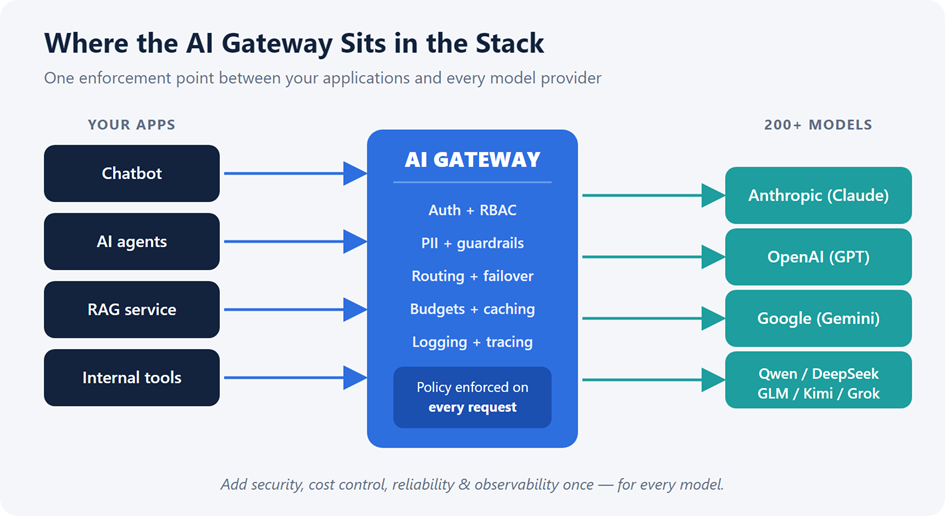
Where the AI gateway sits: a single enforcement point between your apps and every model provider.
What is an AI gateway?
An AI gateway is a unified proxy that intercepts every call your applications make to large language models. Instead of each service holding its own provider keys and calling OpenAI, Anthropic, or Google directly, requests flow through one endpoint that authenticates, applies policy, routes to the right model, and logs the result. It graduated from convenience to critical AI infrastructure in 2026, where unified access, caching, routing, fallbacks, budget enforcement, and compliance logging all live in one layer.
The driver is governance pressure as much as engineering convenience. Gartner forecasts spending on AI governance platforms to more than double from $492 million in 2026 to over $1 billion by 2030 as fragmented AI regulation expands to cover roughly 75% of the world’s economies. The gateway is where those controls get enforced.
See also: Urban Technology Trends
AI gateway vs. API gateway
They sound similar, but they operate at different layers. A traditional API gateway routes traffic it treats as opaque — it works at the header level and counts requests. An AI gateway has to inspect the payload itself because the risk and the cost live in the content.
| API gateway | AI gateway | |
| Unit of work | Request / endpoint | Token, prompt, model response |
| Cost model | Counts requests | Tracks token spend per user/model |
| Routing | Static path-based | Dynamic, by cost/latency/availability |
| Caching | URL + header keys | Semantic, via embeddings |
| Security focus | Auth, rate limits | + PII redaction, prompt-injection defense, content guardrails |
| Streaming | Often breaks SSE | Native token streaming |
Most organizations run both. The API gateway stays in front of conventional services; the AI gateway sits in front of every model call.
The four pillars of an AI gateway
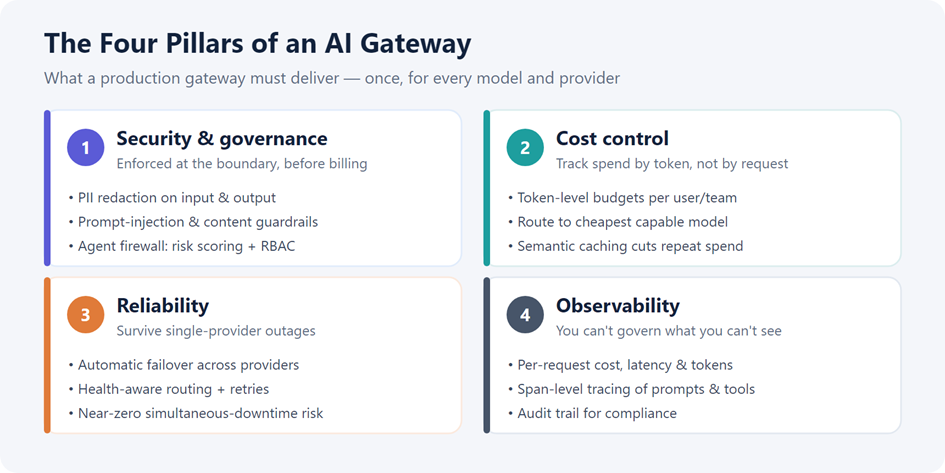
The four capabilities a production AI gateway must deliver — once, for every model.
1. Security and governance
This is where the gateway earns its place. It enforces controls at the boundary, before a request ever reaches a provider: input rules catch prompt injection and PII entering the model, output rules catch PII leakage, toxic generations, and indirect-injection fallout. Because controls live at the gateway, every model call inherits the same policy instead of each app re-implementing it. With the EU AI Act’s high-risk obligations applying from August 2026, runtime enforcement — not a policy document — is what auditors look for. For agentic systems, the gateway doubles as an agent firewall: risk-scoring requests and blocking anomalous behavior before it’s billed.
2. Cost control
LLM bills scale with tokens, not requests, so traditional rate limiting can’t see your real exposure. An AI gateway provides token-level cost attribution per user, team, or model with real-time budget enforcement that stops overspend before it happens. Intelligent routing sends each prompt to the cheapest model that can handle it, and semantic caching avoids paying twice for equivalent queries. This is also where shadow AI gets reined in: without a central control point, over half of enterprise GenAI usage runs unmanaged, with costs nobody can see.
3. Reliability
Single-provider dependence is a liability. LLM providers operate at roughly 99.0–99.5% uptime — a 6–14x higher downtime exposure than the 99.97% the big-three clouds maintain, and industry-wide LLM uptime actually fell between 2024 and 2025. A gateway absorbs that risk with automatic failover: when the primary model errors, rate-limits, or times out, the request reroutes to a healthy provider. Spread across enough providers, the probability of simultaneous downtime approaches zero — which is why 40% of production LLM teams adopted multi-provider routing well before it was standard.
4. Observability
You can’t govern what you can’t see. The gateway logs every request with cost, latency, token counts, model chosen, and the key that issued it, giving span-level tracing across prompts, tool calls, and guardrails plus the audit trail compliance requires. That single source of truth is what makes cost attribution, debugging, and incident response possible.
Why every production AI app needs one
The pattern repeats: teams ship an LLM feature wired directly to one provider, then discover they have no way to redact PII, cap a runaway agent’s spend, survive a provider outage, or explain a bill. Re-implementing those controls per app is slow and inconsistent. An AI gateway gives you them once, for every model — the model-agnostic enforcement point that turns ad-hoc AI usage into governed infrastructure.
Frequently asked questions
What is an AI gateway? A centralized control plane between your applications and LLM providers that enforces security, cost, routing, and logging policy on every model request in the request path, rather than reporting on it afterward.
Is an AI gateway the same as an API gateway? No. An API gateway routes opaque traffic at the header level; an AI gateway inspects the payload to track token costs, apply guardrails, and route by model. Most teams run both.
What’s the difference between an AI gateway and an LLM gateway? The terms are used interchangeably; “LLM gateway” emphasizes the model-routing role, while “AI gateway” is the broader umbrella covering security and governance too.
Does an AI gateway add latency? Well-built gateways add negligible overhead — guardrail enforcement at scale can cost as little as microseconds per request — and they often reduce effective latency via caching and failover.
Why does an AI app need a gateway? Because security (PII, guardrails), cost control, multi-provider reliability, and observability are all best enforced at one boundary instead of being rebuilt inside every app and agent.