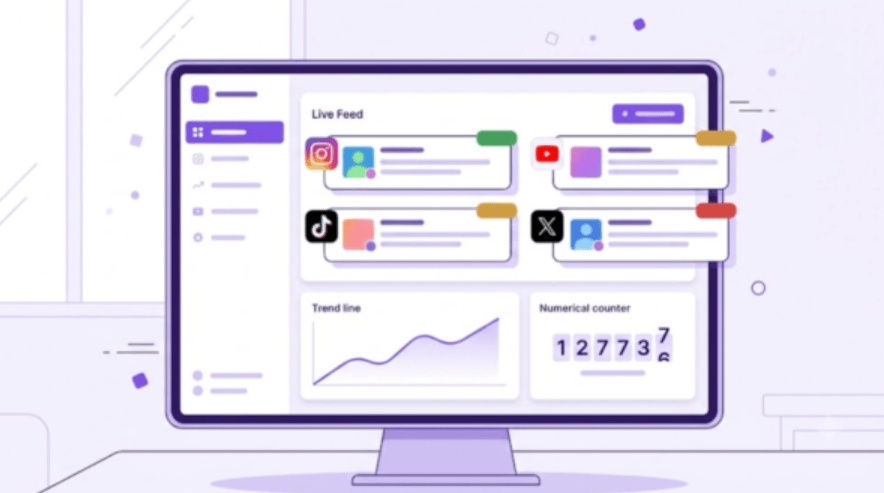
Social Media API + Media Monitoring API: Never Miss a Brand Mention Again
| TL;DR Your customers are talking about you right now. On TikTok, in news stories, across forums and review pages. The problem? Most teams run five different tools and still miss the post that turns into a PR fire. One combined social media API + media monitoring API fixes that. Every mention lands in a single feed, in real time. You catch problems in minutes, keep an eye on competitors without ten open tabs, and feed clean data straight into your own product. Phyllo gives you that one data layer, live in under a week. |
| Direct Answer A social media API and media monitoring API is a programmatic link that pulls mentions, sentiment, reach, and engagement from social and news sources, then hands it back as clean, structured data your app reads instantly. Put simply, it watches the web for you and reports who said what, where it happened, and how people feel, the moment it goes live. |
You heard about it too late. Again.
A creator tags your brand in a video at 11pm. By sunrise the clip has 200,000 views, the comments have turned sour, and your team hears about it from a customer email that opens with a sentence no founder wants to read. The whole thing unfolded without you. You walked into your own party after the music stopped and the cake was gone.
This happens every day to brands that still chase mentions by hand. The web never sleeps. People discuss you on apps you rarely open, in languages you do not read, at hours you are offline. A social media API + media monitoring API shrinks that gap to almost nothing. It listens across every surface, around the clock, and surfaces the signal while it still counts. Treat it as a real-time brand mention tracker plugged straight into the tools your team already uses.
So do you need a bigger team to pull this off? No. You need better plumbing. That is the part Phyllo handles for you.
| By the numbers (2025–2026) The media monitoring tools market hit $6.30 billion in 2025 and tracks toward $7.34 billion in 2026, a 12.3% CAGR. (Fortune Business Insights)The social media analytics market climbed from $16.53 billion in 2025 to a forecast $20.3 billion in 2026.Roughly 86% of advertisers now run generative AI, and AI content is projected to fill 40% of video ads.Social users passed 5.66 billion in 2026. That is 5.66 billion people who could name-drop your brand at any second. |
Why “track every mention” stopped being a nice-to-have
Not long ago, a single daily check on your brand felt responsible. Today one post can swing public opinion before your second coffee. Speed rewrote the rulebook. So did the number of corners a conversation can spark from.
The price of finding out late
Slow detection costs you in ways the dashboard never shows. An ignored complaint becomes a thread. The thread becomes a screenshot. The screenshot spreads. By the time you reply, you are no longer handling a comment. You are handling a narrative. Phyllo’s social listening API exists to stop that snowball while it still fits in your hand.
The duct-tape stack most teams live with
Plenty of teams run a few dashboards, a spreadsheet, and one junior marketer hitting refresh. It limps along until it falls over. Data scatters into silos. The numbers never agree. Nobody believes the report. A unified social media monitoring API swaps that patchwork for one trustworthy source. One feed. One format. One screen to watch.
What a social media API and media monitoring API really do
The two parts sound alike, so people blur them together. They pair beautifully, yet they play different roles on the field.
| Layer | What it does | What you get |
| Social media API | Plugs into platforms and fetches structured data from posts, profiles, and engagement. | Likes, views, reach, comments, follower counts, content metadata. |
| Media monitoring API | Sweeps for mentions of your chosen keywords, hashtags, handles, and brand names across sources. | Mention alerts, sentiment, share of voice, trend signals. |
| Together (Phyllo) | One pipeline that fetches and watches at once, live. | A single normalized feed of every mention, ready to act on. |
One distinction trips up even seasoned marketers, so let us settle it. Monitoring tells you that people are talking. Listening tells you why. Monitoring catches the mention. Listening reads the mood in the room. Phyllo delivers both inside the same layer, so you never have to guess at tone or intent.
The real-time edge: from cleanup crew to one step ahead
Live data rewires how a team operates. You stop mopping up messes and start heading them off. Here is how that looks in the real world.
- Crisis response. A negative spike pings you in minutes, not the next morning. You answer while you still hold the pen on the story.
- Sentiment swings. You watch the mood move in real time. A dip warns you early. A surge tells you to back the campaign that is clearly landing.
- Live openings. A creator praises you with zero prompting. You see it, amplify it, and reach out, all inside the hour. That partnership came from a real-time social media monitoring API, not a lucky scroll.
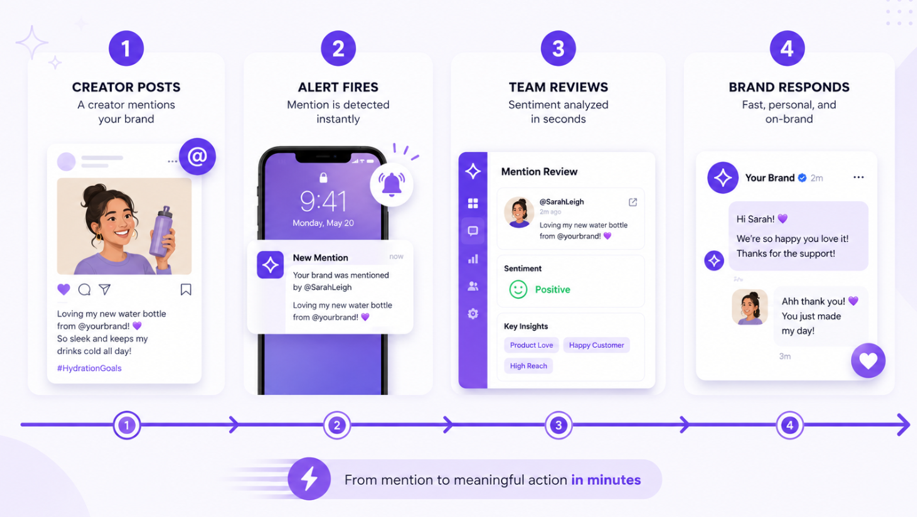
Phyllo pulls conversations from Instagram, TikTok, YouTube, X, and more, then scores each one for sentiment, relevance, and engagement on its own. The analysis that once ate an analyst’s entire day shows up already finished.
The business problems this quietly fixes
Most teams adopt a social media data API to solve one headache. Then they realize it solved five.
- Reputation blind spots. No more hearing about a crisis from a customer. You see it first.
- Thin competitive intel. Track rival mentions and campaigns the way you track your own. Their wins and stumbles become your roadmap.
- Missed sales triggers. Someone asks for a recommendation in your category. You catch it and reply before a competitor does.
- Compliance and risk gaps. Flag risky content tied to your brand or your creators early. Phyllo’s social screening tools carry this into safety and vetting.
- The manual grind. Spare your team the endless tab-refresh. Let them think instead of fetch.
| A quick picture Say you run a skincare brand. A mid-size creator posts that your serum broke her out. Without monitoring, you find the post three days later, buried under 4,000 angry replies. With a real-time feed, you get the alert within minutes, reach out privately, send a replacement, and turn a public complaint into a follow-up video where she thanks you. Same event. Opposite outcome. The only variable was speed. |
Who comes out ahead, and what they gain
Enterprises
Scale monitoring across markets, languages, and brands without scaling the payroll. One media intelligence API feeds every team that needs the numbers.
Agencies
Hand clients proof, not promises. Pull tidy reports on reach, sentiment, and share of voice that defend the retainer and lock in the renewal.
See also: From Idea to Mass Production: How Technology Is Accelerating Hardware Innovation
Creators, startups, and lean teams
Get enterprise-grade awareness on a startup wallet. Phyllo’s APIs trim integration cost by up to 80%, so a small crew gets big-brand visibility. Build your creator tools on top and ship in under a week.
| Real outcomes teams report Response times measured in minutes, not hours.Sharper targeting drawn from the exact words your audience uses, not a hunch.Stronger retention, because you reach people before frustration turns into churn.Up to 80% lower integration cost against building platform connections in-house. |
Best practices for getting it right
Ask yourself one thing before launch: am I set up to catch signal, or just noise? A social media API + media monitoring API rewards a few smart habits and punishes lazy setup.
- Choose keywords with care. Track your brand, your products, common misspellings, your rivals, and your category terms. Drop the vague ones that bury you in junk.
- Tune your alert thresholds. Do not ping on every mention. Ping on spikes, on negative sentiment, on named accounts. Guard your team’s focus.
- Structure data from day one. Tag mentions by sentiment, platform, and topic right away. The you of next quarter will send thanks.
- Route it where work happens. Push alerts into Slack, your CRM, or a BI dashboard. Insight stuck in a tool nobody opens is insight wasted.
- Honor limits and consent. Watch rate limits and data rules. Phyllo touches only consent-based and public data, which keeps you square with platform terms and GDPR.
Where this is headed: AI, voice, and agentic search
Monitoring used to mean counting mentions. Now it means making sense of them. AI reads sentiment, picks up intent, and flags an odd pattern before a human spots it. Phyllo bakes this in, scoring conversations for tone and relevance the second they arrive.
Meanwhile the search layer is shifting beneath everyone. People quiz voice assistants and AI chatbots about brands now. Answer engines and AI Overviews sum up your reputation before a buyer ever reaches your homepage. A solid brand monitoring API feeds the data that shapes how those systems describe you. The brands tracking every mention today are quietly teaching the answer engines of tomorrow. None of this is distant. It is already underway across the creator economy right now.
How to choose the right API
No two social media monitoring API options are built the same. Weigh these five before you sign anything.
| What to check | Why it matters |
| Coverage breadth | More platforms and sources mean fewer blind spots. |
| Latency | Real time should mean minutes, not next-day batches. |
| Data accuracy | Deduplicated, normalized data saves you the cleanup. |
| Scalability | It should grow with you without breaking or repricing painfully. |
| Developer support | Clear docs and quick integration get you live in days, not months. |
Phyllo holds up on all five. Deep integrations to hundreds of creator platforms, real-time normalized data, and an average integration under seven days. You can see the platform coverage here or read the full rundown on the social listening API page.
Where most tools leave you stranded
Loads of platforms hand you a pretty dashboard. Far fewer give developers raw, structured access to build on. That is the gap. A dashboard shows you the data. An API lets you embed that data inside your own product, your own CRM, your own flow. One serves a marketer for an afternoon. The other powers a business for years.
Google Trends will not reveal social dialogue. Standalone listening tools fence you inside their interface. Phyllo plays it the other way. It hands you the pipeline and steps aside, so you build the experience your users actually want.
Who this is for
Readers who land here tend to fit a few profiles. Product teams building a creator SaaS tool. Agencies hungry for client-ready reporting. PR and brand leads dreading the next surprise. Developers weighing a social data API against building connections from scratch. Their question is always practical: what do these APIs do, how do they differ, what do they cost in effort, and which one ships fastest? This guide answers all four, and Phyllo answers the last with a sub-seven-day integration.
See also: The Growth of Tokenized Financial Markets
Common mistakes to avoid
- Tracking everything. A thousand pointless keywords smother the ten that count.
- Skipping context. A mention spike means little without a baseline. Hold onto your history.
- Set and forget. Your market moves. Your tracking should move with it. Revisit it monthly.
- Mixing up monitoring and listening. Counting mentions is not understanding them. Pick a tool that does both.
| Ready to catch every mention? Stop hearing about it late. Start seeing every conversation about your brand the second it happens. Book a demo with Phyllo or explore the social listening API and get your real-time mention feed live this week. |
Frequently asked questions
What is the difference between a social media API and a media monitoring API?
A social media API pulls structured data straight from platforms, such as likes, reach, and post details. A media monitoring API hunts those same platforms for mentions of your keywords and brand. One retrieves the data, the other keeps watch for it. Phyllo folds both into a single live pipeline.
Can these APIs track mentions in real time across every platform?
Yes. Phyllo gathers conversations as they break across major platforms like Instagram, TikTok, YouTube, and X. The reach depends on platform permissions and user consent, which keeps everything compliant and clean.
How does a social media API + media monitoring API pay for itself?
It buys back time, heads off crises, and surfaces sales cues you would otherwise lose. Teams point to quicker responses, tighter targeting, and integration costs up to 80% below building platform links themselves.
Does real-time media monitoring make sense for a small business?
Very much so. Small teams gain big-brand awareness without the headcount. You can follow niche communities and local sentiment, then act fast. Phyllo keeps that within reach for startups, not only enterprises.
What data can these APIs collect and analyze?
Mentions, sentiment, reach, engagement metrics, hashtags, audio and location trends, and source details. Phyllo’s built-in AI also rates each conversation for relevance and tone on its own.
How is social listening different from social monitoring?
Monitoring registers that people mention your brand. Listening digs into the context, tone, and intent behind those mentions to explain the why. Phyllo serves both in one data layer, so you act on the whole story.