Multilingual Speech Data Pipelines: 8 Tests Before You Sign
Multilingual speech data collection services recruit, record, verify, and transcribe native speakers across languages, then deliver audio ready for ASR training. The good ones prove quality with rejection rates, consent documents, and per language WER evidence. The rest sell you hours. These 8 tests separate the two before you commit a training budget.
The 8 tests at a glance
1. Ask which countries their speakers actually live in
2. Ask how they verify speaker identity and demographics
3. Ask what their QC rejects, and at what rate
4. Ask for spontaneous and code switched speech, not just read scripts
5. Ask about recording hardware, sample rates, and noise conditions
6. Ask how consent, licensing, and biometric law are handled
7. Ask how they keep your eval set clean
8. Ask for per language WER evidence from a paid pilot
1. Ask which countries their speakers actually live in
A credible vendor names the countries, cities, and dialect regions where its speakers live, not just the languages on a rate card.
“Language” hides variation. A single language named on a rate card can span several distinct dialect regions, and a model trained on one will stumble on the others. The same holds for any widely spoken language whose regional varieties differ in vocabulary and pronunciation. Around 7,000 languages are spoken worldwide. Commercial ASR covers roughly 100 to 150 of them, and the gap sits across the Global South and other low-resource language regions. Ask for a speaker map. A vendor sourcing a low-resource language should tell you how speakers are distributed across its major dialect regions, because those regions differ in vocabulary and pronunciation. If the answer stays at the language level, the diversity claim is marketing.
Why it matters: Your model ships to real users in specific places, and accent mismatch shows up later as WER you already paid for.
2. Ask how they verify speaker identity and demographics
Real verification means identity checks, recorded fluency screening judged by native reviewers, and demographic quotas enforced per language, not self reported forms.
Open crowdsourcing lets anyone claim any language. That is how a Tagalog dataset ends up with second language speakers reading off a screen. The contrast case is public: Mozilla Common Voice holds over 20,000 hours across 100 plus languages, but quality varies from recording to recording and some languages carry only a few validated hours, precisely because contribution is open. A strong vendor screens applicants with a recorded fluency test, verifies identity, and fills quotas across age bands, gender, and region. Ask what percentage of applicants they reject at screening. A number above zero is the first honest signal you will get.
Why it matters: You are buying a speaker distribution, not audio files, and an unverified distribution skews your model in ways evals catch too late.
3. Ask what their QC rejects, and at what rate
Serious multilingual speech data pipeline vendors run layered QC and can state a rejection rate per language, typically 10 to 30 percent of raw submissions.
Speech QC has layers. Automated checks catch clipping, silence, wrong sample rates, and noise above threshold. Transcription checks catch mismatches between audio and text. Native reviewers catch mispronunciations, wrong dialects, and read errors that automated tools miss. Each layer discards data. If a vendor claims near zero rejection, either their contributors are flawless or nobody is checking. Rejection also varies by task: spontaneous conversation in a low-resource language fails QC more often than read scripts, so ask for the rate per language and per speech type. Then ask who absorbs the cost of rejected audio. If the answer is you, walk.
Why it matters: Discarded data is the difference between 1,000 clean hours and 1,000 billed hours.
4. Ask for spontaneous and code switched speech, not just read scripts
Read speech alone trains a model that fails on real conversation, so demand spontaneous, conversational, and code switched collection options.
Read speech is cheap and easy to transcribe because the text is known in advance. That is why vendors default to it. But production audio contains disfluencies, false starts, overlapping turns, and speakers switching languages mid sentence. Across the Global South, blended speech that mixes a local language with a colonial or trade language is not an edge case. It is how hundreds of millions of people talk. Whisper trained on 680,000 hours of audio and its weakest results still land on conversational and accented speech in lower resource languages. Ask a vendor to play you five minutes of their spontaneous collection in your target language. Scripted sentences read in a quiet room will not save your model in a noisy call center.
Why it matters: Your users will not read scripts to your model, so your training data cannot either.
5. Ask about recording hardware, sample rates, and noise conditions
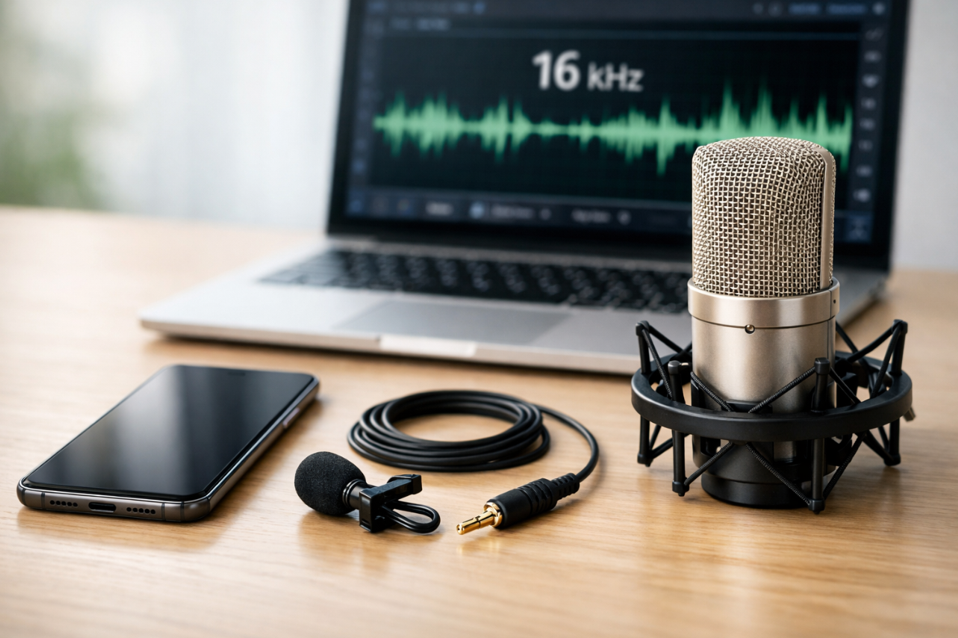
The vendor should specify capture devices, a 16 kHz minimum sample rate for ASR work, target signal to noise ratios, and controlled versus in the wild conditions for every batch.
ASR training standardizes on 16 kHz. TTS work needs 44.1 or 48 kHz. A vendor that cannot tell you which they deliver has not thought about it. Device mix matters too. A asr dataset recorded entirely on studio microphones underprepares a model for smartphone audio, and far field recordings captured at two to five meters are mandatory if you ship to smart speakers or meeting rooms. Ask for the noise floor. Clean collection typically targets a signal to noise ratio of 20 dB or better, with deliberately noisy batches added on top for augmentation. The right answer to this question is a spec sheet, not a reassurance.
Why it matters: Acoustic mismatch between training and deployment conditions is one of the most common causes of production WER surprises.
6. Ask how consent, licensing, and biometric law are handled
Voice is biometric data in several jurisdictions, so demand written per speaker consent that names AI training and commercial use as the purpose and spells out your downstream rights.
GDPR treats voice as special category biometric data under Article 9 when it is processed to identify a person, and explicit consent is the lawful basis that holds up. Illinois BIPA has produced nine figure settlements over biometric collection without proper consent. Scraped podcast or video audio carries none of the consent chain you need, and the training data lawsuits moving through courts since 2023 have made provenance a due diligence item for acquirers and enterprise customers. Ask to see the actual consent form a speaker signs, in the speaker’s own language. Ask who holds liability if a speaker revokes. A vendor with a real pipeline answers in one email. A reseller of scraped audio changes the subject.
Why it matters: A licensing gap in your training set becomes your legal exposure, not the vendor’s.
See also: Understanding the Pace of Technological Advancement
7. Ask how they keep your eval set clean
The vendor must guarantee your evaluation data never overlaps public benchmarks, other clients’ deliveries, or transcripts generated by an existing ASR system.
Contamination in speech has a specific failure mode. If your eval audio resembles LibriSpeech or Common Voice, a model pretrained on those corpora scores well on your eval and fails in production. There is also a circular trap: some vendors transcribe collected audio by running it through an existing ASR model, which means your new model trains on the errors of the old one. Ask three things. Are transcripts produced or verified by humans? Are your speakers and prompts exclusive to your project? Is delivered audio checked for overlap against public benchmark corpora? Hesitation on the third question tells you the check does not exist.
Why it matters: A contaminated eval makes every downstream decision, including renewing this vendor, look better than it is.
8. Ask for per language WER evidence from a paid pilot
Before a full contract, run a paid pilot of 10 to 100 hours in one language and measure WER lift on a held out test set the vendor never sees.
Fine tuning an existing model like Whisper on a specific language or domain takes 10 to 100 hours of quality data, which makes a pilot cheap relative to a training run. Structure it as a real test. You define the held out eval set, the vendor never touches it, and you measure word error rate before and after fine tuning on their delivery. Ask for the vendor’s prior per language results too, but weight your own pilot higher. Aggregate claims like 95 percent accuracy hide the languages that drag. A vendor confident in their pipeline agrees to pilot terms in writing. One that pushes for a full commitment first is telling you what their data would show.
Why it matters: Eval lift on your own test set is the only number that survives contact with your budget review.
Where multilingual speech data comes from
| Source | Consent and license | Contamination risk | Best use |
| Public benchmarks (LibriSpeech, Common Voice) | Open licenses, consent handled upstream | High. Most models already trained on them | Benchmarking and prototyping only |
| Scraped audio (podcasts, video platforms) | No speaker consent, unresolved rights | High, plus ASR transcription circularity | Avoid for production training |
| Your own product audio (calls, app usage) | Depends on your terms of service | Low if held out properly | Domain adaptation and eval sets |
| Custom collection service | Written per speaker consent | Low. Exclusive speakers and prompts | Production training in target languages |
Where Humyn Labs fits
Humyn Labs runs the full speech pipeline: sourcing, validation, multi-layer QC, human transcription review, annotation, and human-in-the-loop review, delivered through a verified first-party contributor network spanning 50 plus languages with deep coverage across Global South and other low-resource languages, and written consent for every speaker. The pipeline delivers read, spontaneous, code switched, and far field speech to your spec, alongside speech recognition training data for fine tuning runs. If you are scoping a language list, send it over. We will tell you plainly which languages we cover deeply today and which we would need to build out for you.
CTA: Send us your target language list.
FAQ
How many hours of speech data do you need to train an ASR model?
Training a speech to text model from scratch takes 1,000 plus hours per language. Fine tuning an existing model like Whisper for one language or domain takes 10 to 100 hours of clean transcribed audio. Low resource languages usually start with fine tuning because collection cost scales with hours.
Can you train speech recognition on YouTube or podcast audio?
You can, but you should not for production. Scraped audio lacks speaker consent, carries unresolved licensing risk, and is often transcribed by existing ASR systems, so your model learns their errors. Custom collected audio with human verified transcripts avoids all three problems and survives legal due diligence.
What counts as a low resource language in ASR?
A low resource language has little transcribed audio available for training, often under a few hundred validated hours. Most of the roughly 7,000 languages spoken worldwide qualify, including a wide range of Global South and other low-resource languages. Commercial ASR covers only 100 to 150 languages, and quality drops fast outside the top twenty.
How much does multilingual speech data collection cost?
Multilingual speech data pipeline vendors price per audio hour, and rates vary with language rarity, speech type, and QC depth. Read speech in high resource languages sits at the low end. Spontaneous or code switched collection in low resource languages costs several times more. Always ask for per language quotes.
How do vendors verify speech data quality?
Strong vendors layer three checks: automated audio validation for sample rate, clipping, and noise, transcription review against the audio, and native speaker review for dialect and pronunciation. Expect 10 to 30 percent of raw submissions to fail. A vendor that reports rejection rates per language is showing you real QC.
Is voice data biometric data under GDPR?
Yes. When voice is processed to identify a person it falls under GDPR Article 9 as special category biometric data and needs explicit consent. Illinois BIPA imposes similar duties in the US. For AI training, get written per speaker consent that names commercial model training as the purpose.
Pick the vendor that answers with numbers
The vendors worth your budget answer all eight tests with documents, rates, and pilot terms. The rest answer with adjectives. Send Humyn Labs your target languages and get a straight answer on coverage, cost, and timeline for a full multilingual speech data pipeline built for your next training run.