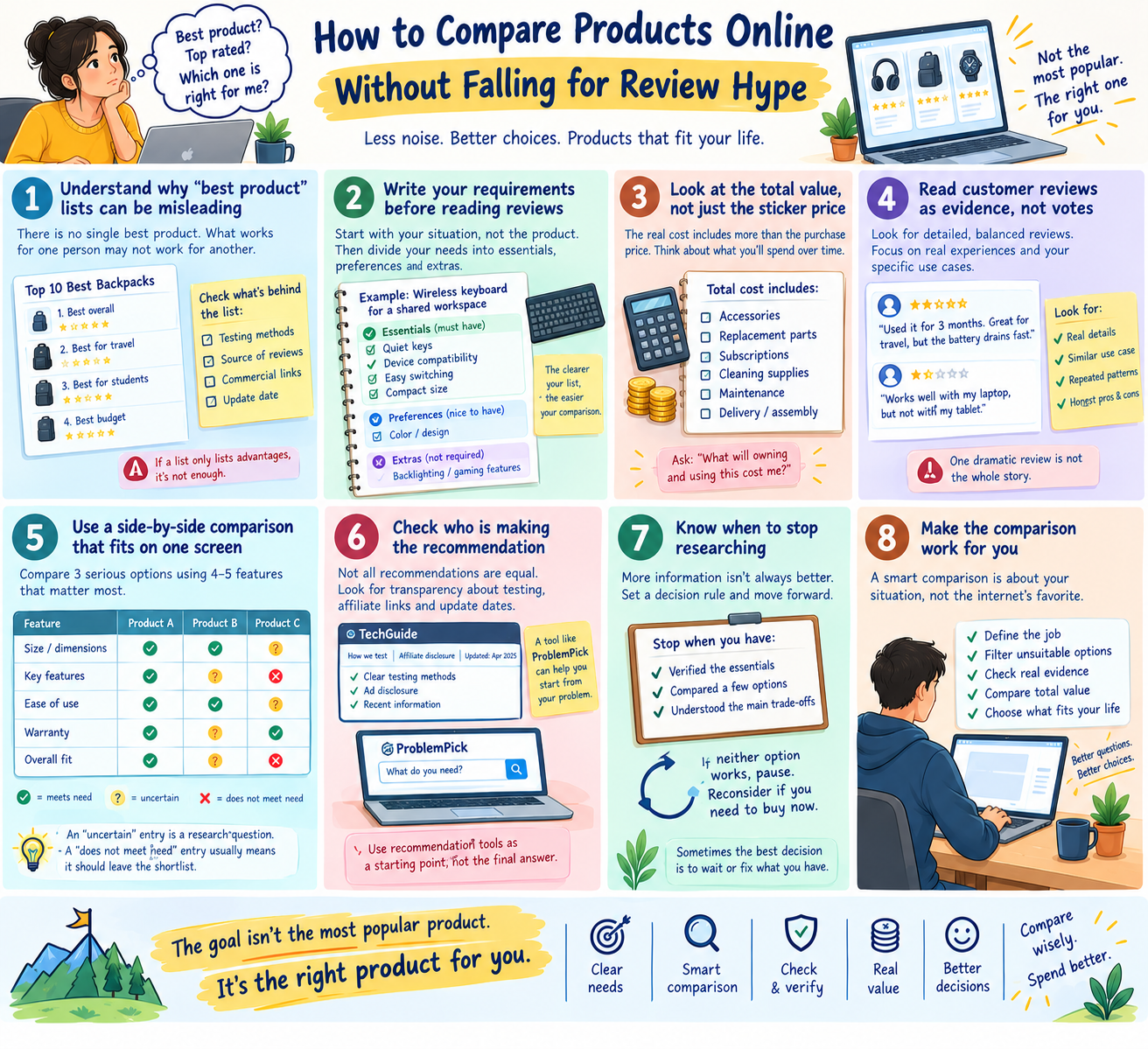
How to Compare Products Online Without Falling for Review Hype
Shopping online is convenient until every product appears to be the winner. One website praises battery life, another emphasizes design, and a third declares a different model the best overall. Reviews can be useful, but the flood of rankings, star ratings, and promotional messages often makes it harder to see which differences matter.
A better product comparison begins with your own requirements. Once those are clear, specifications and reviews become evidence you can evaluate—not instructions you have to follow.
The hidden problem with “best product” lists
There is no universal best backpack, kitchen appliance, or pair of headphones. A backpack that suits frequent travelers may be too bulky for a daily commute. A compact appliance that works for one person may be inconvenient for a larger household.
Many online rankings combine several types of information: direct testing, manufacturer claims, customer ratings, editorial opinion, and sometimes commercial arrangements. These sources are not interchangeable. Before trusting a ranking, check whether the author explains how the products were selected and tested.
If a list offers only advantages and uses the same praise for every item, it gives you little basis for a real comparison.
See also: How Modern Lending Technology Is Transforming Loan Operations
Write a requirements list before reading reviews
Start with a short description of your situation. Imagine you need a wireless keyboard for a small shared workspace. You might care about quiet keys, device compatibility, easy switching, and dimensions more than colorful lighting or gaming features.
Divide requirements into essentials, preferences, and extras. Essentials are disqualifiers: the product must meet them. Preferences help rank suitable candidates. Extras are pleasant but should not dictate the decision.
This prevents the common mistake of choosing a product for an impressive feature you will rarely use.
Compare total value, not just sticker price
Two products with similar prices may cost very different amounts over time. Consider necessary accessories, replacement parts, subscriptions, cleaning supplies, and likely maintenance. A lower purchase price is not a saving if the item needs expensive consumables or does not work with the equipment you already own.
For example, a printer with a low advertised price might require frequent ink purchases. A storage device might need an additional adapter. A small appliance might consume space you cannot spare. These factors rarely stand out in headline prices but can shape whether a purchase is satisfying.
Ask, “What will owning and using this cost me?” rather than only “What does it cost today?”
Read customer reviews as evidence, not votes
Star averages can hide valuable context. Two products with similar ratings may have completely different strengths and weaknesses. Read a mix of detailed positive and critical reviews, especially those describing use cases similar to yours.
Look for specific observations: how long someone used an item, which device it was paired with, what happened when a problem arose, and whether a claimed feature performed as expected. Be skeptical of reviews that repeat marketing language without describing use.
Do not assume every negative review is decisive. A complaint about a feature you do not need may have little relevance. Conversely, several independent reports of a compatibility problem could matter a great deal.
Use a side-by-side comparison that fits on one screen
You do not need a complicated spreadsheet. List three serious candidates and evaluate the four or five features that directly support your goal.
For a small-room fan, the comparison might cover physical size, available settings, cleaning access, sound considerations, and warranty. For a backpack, it might cover measurements, pocket layout, materials, weight, and returns.
Mark each criterion as meets need, uncertain, or does not meet need. An “uncertain” entry is a research question. A “does not meet need” entry means the product should usually leave the shortlist.
This method is especially helpful because it makes missing information visible rather than allowing polished photographs to fill in the gaps.
Check who is making the recommendation
Some publishers test products themselves. Others summarize publicly available information or use affiliate links to earn a commission when readers buy. These approaches can serve readers, but transparency matters.
Look for a clear explanation of testing methods, advertising relationships, and update dates. Prices and availability change quickly, so an old comparison may remain helpful for design or durability observations while being unreliable for current deals.
Product discovery tools can also assist with early filtering. A site such as ProblemPick starts from the problem a shopper wants to solve, which can be useful before comparing individual listings. It should complement—not replace—independent checks of specifications, reviews, and purchase terms.
Know when to stop researching
More information does not always mean a better decision. Once you have verified the essentials, compared a few serious options, and understood the main compromises, endless additional reviews may only repeat the same opinions.
Set a decision rule: if two products meet every essential requirement, choose based on your highest-priority preference and the clearer seller policies. If neither qualifies, reconsider whether you need to buy now.
Pausing can be a valid outcome. Sometimes an existing item can be repaired, borrowed, or adjusted to solve the problem without another purchase.
Make the comparison work for you
Smart online comparison is less about finding the internet’s favorite product and more about choosing for your own circumstances. Define the job, filter out unsuitable options, test marketing claims against credible evidence, and compare total value. Good reviews should make the trade-offs clearer—not replace your ability to make them.