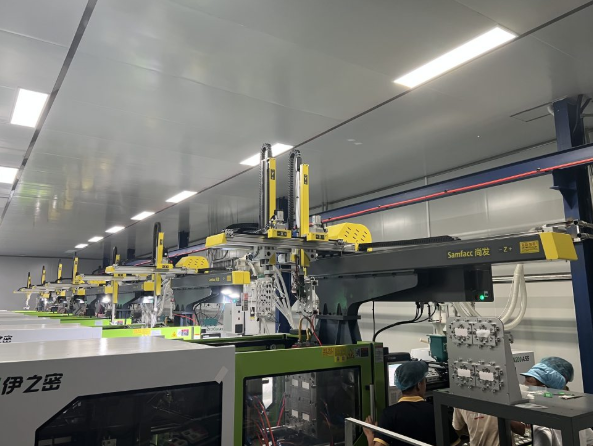
Counting the Benefits of Automation for a Vertical Injection Molding Machine
Every manufacturer wants steady output, good quality and a safe workplace, and every manufacturer also has to watch costs. Automation can help with all of these, but it is not free and it is not always the right answer. If you operate a vertical injection molding machine, this article looks honestly at what a robot for part removal can offer, how to estimate its value, and what to check before you decide.
What Automation Means Here
In this context, automation usually means a robot that takes the finished product, or the attached material head, out of the mold area and places it on a conveyor or in another set position. Samfacc, a manufacturer of such robots, states that its arm robots are made for this job, and that they are available in single arm and double arm designs.
The robot does not change the molding process itself. It takes over the repeated handling step so that people can focus on tasks that need judgement.
The Benefits the Manufacturer Describes
The manufacturer’s page lists several advantages of its robots: energy saving, efficiency, safety, cost effectiveness, customization and space saving. It also says the robots help reduce human labour and the risk of bodily injury. These are the claims of the maker, so it is wise to treat them as a starting point and to ask for supporting details that apply to your own machine and product.
In general terms, the main benefits that part removal automation can bring are:
- A steadier cycle. A robot repeats the same movement every time, which helps the cycle stay regular.
- Less manual handling. Fewer repeated movements near a hot mold can mean less strain on workers.
- A cleaner workspace. Parts go straight to a conveyor instead of being left in bins or on tables.
- Better use of people. Staff can be moved to inspection, packing, setup or maintenance.
What Automation Does Not Do
It is just as important to be clear about the limits. A robot will not repair a poorly made mold, correct wrong temperature settings or remove the need for training. It also adds new tasks, such as inspecting the robot, keeping it clean and replacing worn parts. If these are ignored, the benefits can disappear quickly.
A Simple Way to Estimate Value
You do not need complicated software. Try these steps with honest numbers.
- Count your cycles. How many parts or cycles does the machine run in a normal day?
- Measure the manual step. How much of each cycle depends on a worker removing the part, and how often does the machine wait?
- Add up labour time. Estimate the time and cost of the person who stands at the machine.
- Note quality losses. How many parts are scratched, deformed or dropped during manual handling?
- Ask for real figures. Request the robot’s price, installation cost, power use and expected maintenance from the supplier.
- Compare. Put the monthly cost of the present method beside the monthly cost with a robot, then divide the total investment by the monthly difference to see roughly how long it would take to recover it.
Treat the result as an estimate, not a promise. If the payback looks very long, it may be better to wait until your volume grows.
Costs That Are Easy to Forget
The purchase price is only one part of the picture. Remember installation, any changes to the layout, conveyors, training, spare parts, routine maintenance and the time your team needs to learn the new system. A fair comparison includes all of these.
Is Your Workshop Ready?
Before buying, check a few practical points. Is there enough space beside the machine? Is the cycle long enough and the product simple enough for a robot to handle? Do you have someone who can be trained to operate and look after it? Are your safety rules clear and followed? If the answers are mostly yes, automation may be a sensible next step.
Customization
The manufacturer states that its robots can be customized for particular applications. If your product has an unusual shape, weight or position, ask the supplier exactly what can be adjusted and what the cost and delivery time would be. Get all agreements in writing, with clear terms for both sides.
Where to Start Reading
If you want to see what is available, the manufacturer’s page for a vertical injection molding machine describes its vertical robot range and the benefits it claims. Read it carefully and write down questions for the supplier.
Final Thoughts
Automation is a tool, and it works best when it solves a real problem. Look closely at your own cycle, your labour, your space and your quality losses, ask for clear figures and avoid expecting more than the numbers show. With honest planning, a well chosen robot can make your production steadier and your workplace safer.