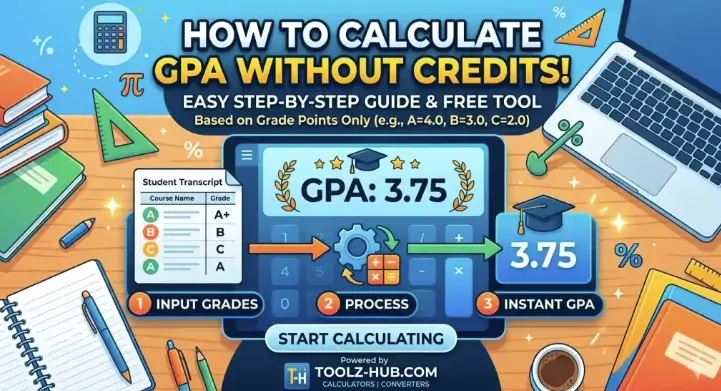
How to Work Out Your GPA When You Don’t Have Credit Hours
Most GPA guides assume you’re holding a neat transcript with a credit value printed next to every course. Real life isn’t always that tidy. Middle-school report cards rarely list credits, plenty of high schools give every subject the same weight, and sometimes you just want a quick estimate mid-semester before the official numbers land. The good news is that you don’t need credit hours at all to get an accurate GPA in these situations. Here’s exactly how to do it, step by step.
Why Credit Hours Aren’t Always Necessary
Credit hours exist to make bigger courses count more. A four-credit lecture should pull on your GPA harder than a one-credit lab, and the credit-weighted formula handles that. But when every course carries the same weight — which is the case in most middle schools and many standard high-school tracks — there’s nothing to weight. Each class counts once, so a plain average of your grade points gives you exactly the same result as the credit-weighted method. Skipping credits isn’t a shortcut in these cases; it’s simply the correct approach.
Step 1 — Turn Each Grade Into a Point Value
A GPA is an average of grade points, not of letters or percentages, so the first job is to translate every grade into its number on the 4.0 scale. On the standard scale an A is 4.0, a B is 3.0, a C is 2.0, and the plus and minus grades fill the gaps — a B+ is 3.3, an A− is 3.7, and so on. If you only have percentages, map each one to its letter first, then to its point value.
Rather than memorizing the whole table, you can convert each letter grade into its point value in a couple of taps — handy when you have a mix of letters and percentages and want to be sure you’re reading the boundaries correctly before you start averaging.
See also: Why Professional Corporate Transport Matters for Growing Businesses
Step 2 — Average Them the Simple Way
Once every course is a number, the rest is a plain average: add up all the grade points and divide by how many classes you have. Say a student earned A, A−, B+, B, B, C+, and A across seven subjects. Their points are 4.0, 3.7, 3.3, 3.0, 3.0, 2.3, and 4.0, which add up to 23.3. Divide by 7 and the GPA is 3.33. No credit hours, no quality points, no complicated formula — just a straightforward mean.
Doing that by hand across a full course load is easy to fumble, especially with plus and minus values in the mix, so it’s quicker to let a tool average your letter grades for you — you enter each grade, and it returns the overall GPA instantly without ever asking for a credit value you don’t have.
When This Matches the Credit-Weighted GPA
Here’s the rule that ties it all together: the no-credits average and the credit-weighted formula produce the same GPA whenever your courses all carry equal weight. The credit hours cancel out because they’re identical for every class. The two methods only diverge once your courses have different credit values — a four-credit core class beside a one-credit elective. So before you skip credits, ask one question: do my classes all count equally? If yes, the simple average is exact. If no, you’ll want the credit-weighted method instead to match your official transcript.
Where You’ll Actually Use This
- Middle school report cards. Credits usually aren’t listed at this level, and every subject counts the same, so a plain average is the right call.
- Standard high-school tracks. When every class is worth the same, you don’t need credit hours to get an accurate number.
- Mid-semester estimates. Want a rough GPA before official records post? Averaging your current grades gives you a reliable preview.
- Transferred or incomplete records. If the credit data simply isn’t in front of you, the equal-weight average keeps you moving.
A Few Tips for an Accurate Result
Use the precise plus and minus values — rounding a B+ to 3.0 instead of 3.3 quietly drags your average down. Leave out pass/fail courses, since they carry no grade points and shouldn’t affect the mean. And check your school’s exact percentage cutoffs before converting, because the line between an A− and a B+ isn’t identical everywhere. Small differences at the boundaries are where most GPA miscalculations come from.
The Bottom Line
Not having credit hours doesn’t stop you from knowing your GPA. Turn each grade into its point value, take a simple average, and — as long as your courses count equally — you’ll land on exactly the number your transcript would show. It’s the fastest, cleanest way to track where you stand whenever the credits aren’t in front of you.