The Licence Is the Only Qwen 3.8 27B Detail That Can Ruin Your Plan
Most of what’s unknown about Qwen 3.8 27B is inconvenient. The licence is different: it’s the one blank that can make the model unusable for you no matter how good it turns out to be. And as of August 9, 2026, Alibaba has not published one — the weights aren’t out, and neither are the terms.
Nearly every article on this release assumes Apache-2.0. That assumption is reasonable and it is still an assumption, and this piece is about why the distinction is worth holding onto.
Where the assumption comes from
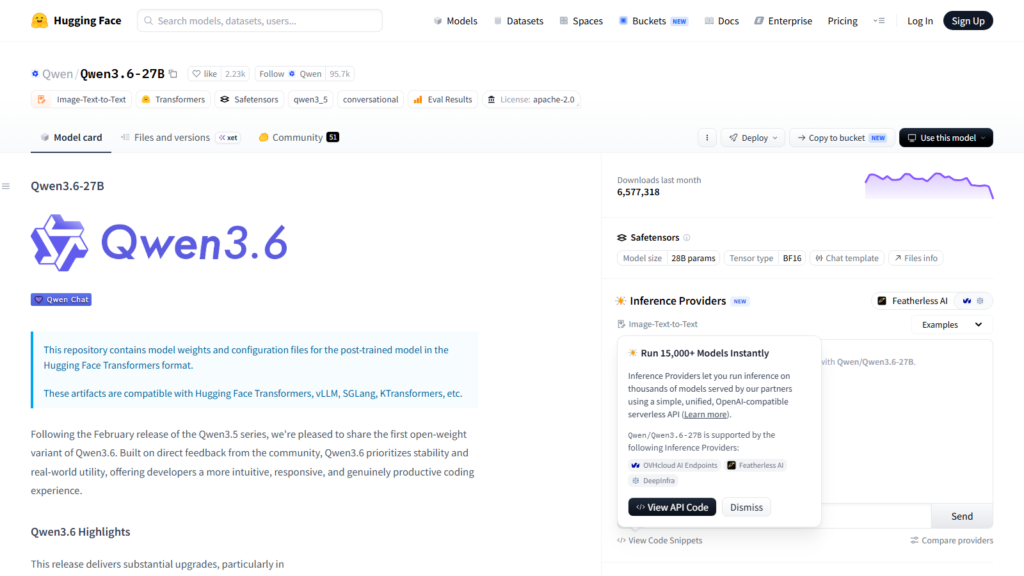
It’s not baseless. Qwen 3.5 and Qwen 3.6 both shipped under Apache-2.0 — the predecessor 27B, released April 2026, carries it on its model card today. Two consecutive generations under the most permissive common licence is a real pattern, and it is why the community expects a third.
Apache-2.0 is about as good as it gets for a deployer: commercial use permitted, redistribution permitted, modification permitted, a patent grant included, and the only substantive obligations are attribution and stating changes. If 3.8-27B lands under it, there is nothing further to think about.
Why this release is precisely the one where a pattern might break
Here is the part that gets skipped. This is the first time a Max-generation Qwen family has carried an open-weights promise at all. Previous Max flagships stayed API-only with no self-hostable sibling. That makes 3.8 a genuinely new kind of release for Alibaba, not the third instance of a routine.
New kinds of release are exactly where terms get revisited. A company opening weights adjacent to a 2.4-trillion-parameter commercial flagship has more to protect than one opening a standalone mid-size model, and the legal question — what can someone do with weights that sit one tier below the product we sell — is different from anything the 3.5 and 3.6 releases had to answer.
There’s a second signal worth naming without over-reading it: the weights are late. Alibaba promised them within the week of the August 3 announcement, and the week has passed with nothing published. Nobody outside the company knows why. But if the hold-up is legal review, then the licence is precisely the thing under review — and the pattern everyone is relying on is the thing that review might change.
That is speculation, and labelled as such. The point is not that the licence will be restrictive. It’s that “probably Apache-2.0” is not a basis for a production commitment.
What each outcome would actually mean
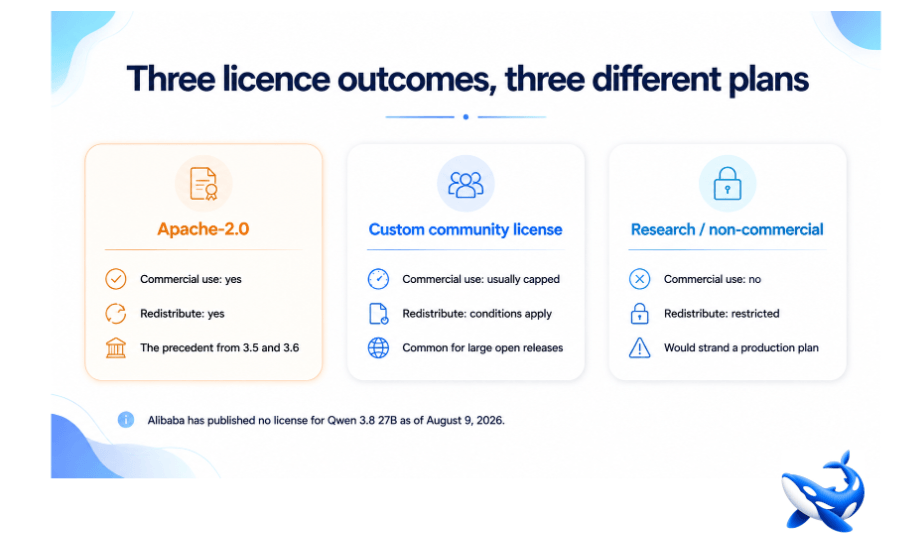
Apache-2.0. Deploy commercially, modify, redistribute, ship it inside a product. No further analysis needed. This is the outcome most people are planning for.
A custom community licence. Increasingly common for large open-weight releases. Typically permits commercial use below some threshold — revenue, monthly active users, or similar — with separate terms above it, plus use restrictions and sometimes attribution or naming requirements. Usable for most teams, but it needs reading, and “most teams” is doing real work in that sentence.
Research or non-commercial only. Would make the model useless for production regardless of quality. Less likely given the precedent, and it is the scenario that turns a hardware purchase into a write-off.
Terms that differ for the vision component, if the model is multimodal like its predecessor. Split licensing across modalities is unusual but not unheard of, and it’s the kind of detail that surfaces only when someone reads the file.
A caution about second-hand licence claims
Third-party repositories named for this model already exist on Hugging Face, and some carry licence metadata. That metadata is the uploader’s, not Alibaba’s.
We checked one on August 9 — a third-party FP8 placeholder that states outright it contains no weights — and its card carries Apache-2.0. The uploader isn’t being dishonest; they’re describing the licence they expect to inherit. But a quantiser’s repository inherits whatever the base model actually ships with, and until Alibaba publishes, no repository on the hub can tell you the licence of Qwen3.8-27B. If your legal review is reading a third-party card, it’s reading a guess.
What to do before the terms exist
Don’t buy hardware for it yet. This is the concrete recommendation. A GPU purchased for a model you may not be permitted to deploy commercially is the one clearly avoidable mistake available here.
Do write down your licence requirement now. Commercial use, redistribution inside a product, fine-tuning and shipping the result, on-premise deployment for a client — whichever of these you need, decide before the release. It takes ten minutes now and prevents a fortnight of debate on drop day.
Do build against something whose terms you’ve already read. Several models in this class ship under licences you can evaluate today: Gemma 4 12B under Apache-2.0, Ling 3.0 Flash and Motif-3 under MIT. And if the real requirement is this generation’s quality rather than self-hosting, Qwen 3.8 Max sidesteps the licence question entirely — hosted, priced, and covered by an ordinary API agreement. If your project has to ship before Alibaba resolves this, one of those is the answer rather than a compromise.
Do consider whether you need weights at all. Plenty of teams waiting on the 27B want Qwen3.8-generation capability, not self-hosting specifically. The flagship — Qwen3.8-Max, 2.4T parameters, 1M context, $2 / $6 per million tokens, and the generation’s only independent score at an Artificial Analysis Intelligence Index of 56 — is callable today under ordinary commercial API terms, with no licence question at all.
See also: Understanding the Pace of Technological Advancement
The takeaway
Architecture, context length and benchmarks are blanks that make planning imprecise. The licence is the blank that can make planning pointless. The Apache-2.0 expectation rests on two prior generations and is genuinely well-founded — but this is the first Max-generation family Alibaba has promised to open, the weights are already late, and a pattern is not a commitment. Write down what terms you actually need, build against something you can already read, and don’t spend money on hardware until the file exists.
Sourcing note: Alibaba has published no licence for Qwen3.8-27B as of August 9, 2026, and the weights are not on Hugging Face. The Apache-2.0 licences of Qwen 3.5 and Qwen 3.6 are those models’ published terms. Speculation about the reason for the delay is explicitly labelled as such — no cause has been stated publicly. Licence metadata on third-party repositories reflects the uploader’s expectation, not Alibaba’s terms. Nothing here is legal advice.